Logo

Online Primary Sources

  • Home
  • All Sources
  • About
  • Newsletter
Filter by
PeriodGeographical areaInstitutionTypeLanguage
  • 18th century (1)
  • 19th century (8)
  • 20th century (11)
  • 21st century (1)
  • Imperial Russia (1)
  • Pre-Soviet Russia (1)
  • Revolution (1)
  • Russian Empire (1)
  • Soviet Union (3)
  • World War II (1)
  • Austro-Hungarian Empire (1)
  • Azerbaijan (1)
  • Baku (1)
  • Belarus (2)
  • Belorussia (1)
  • Bielorussia (1)
  • Bukovina (1)
  • Central Europe (3)
  • Czernowitz (1)
  • Daghestan (1)
  • Eastern Europe (4)
  • Georgia (1)
  • Hungary (1)
  • Imperial Russia (2)
  • Israel (2)
  • Lithuania (3)
  • Moldova (2)
  • Moscow (1)
  • North Caucasus (1)
  • Poland (3)
  • Romania (2)
  • Russia (6)
  • Russian Empire (3)
  • Soviet Union (4)
  • Transcaucasia (1)
  • Ukraine (1)
  • USA (1)
  • Vilna (1)
  • Vilnius (1)
  • Vladikavkaz (1)
  • Blavatnik Foundation (2)
  • Central Jewish Library, Poland (1)
  • DiFMOE Digitales Forum Mittel- und Osteuropa (1)
  • National Library of Israel (2)
  • SEFER Center (1)
  • The Edward Blank YIVO Vilna Online Collections (2)
  • The New York Public Library Digital Collections (1)
  • YIVO Institute for Jewish Research (1)
  • Audio (1)
  • E-book (1)
  • Image (11)
  • Pdf (3)
  • Video (1)
  • Austrian (1)
  • Belarusian (1)
  • English (3)
  • French (2)
  • German (4)
  • Hebrew (11)
  • Hungarian (2)
  • Lithuanian (1)
  • Polish (6)
  • Romanian (3)
  • Russian (8)
  • Serbian (1)
  • Ukrainian (2)
  • Yiddish (11)

11 sources found in the database

for HebrewYiddish
  • Database of Jewish History, Culture, and Material Heritage in Eastern European Countries, Non-European Regions of Russia and the Post-Soviet Space


    SEFER Center

  • The May Cohn Russia and Soviet Union Collection (Vilna Archives) on Jewish life in the Russian Empire and the Soviet Union


    The Edward Blank YIVO Vilna Online Collections

  • Vilna Chief of Police Records, 1831-1918


    The Edward Blank YIVO Vilna Online Collections

  • Jewish German Bukovina Collection


    DiFMOE Digitales Forum Mittel- und Osteuropa

  • Central & Eastern Europe Judaic Newspaper Collection (19th-20th Century)


    Central Jewish Library, Poland

  • Judaica Poster Collection 1910s-1940s


    Blavatnik Foundation

  • Historical Central & Eastern Europe Jewish Press (1860-1939)


    National Library of Israel

  • Yizkor (Memorial) Book Collection in Hebrew & Yiddish


    The New York Public Library Digital Collections

  • The YIVO Encyclopedia of Jews in Eastern Europe


    YIVO Institute for Jewish Research

  • Moscow State Yiddish Theater Collection


    Blavatnik Foundation

  • Historical Jewish Press Collection


    National Library of Israel

  • «
  • ‹
  • 1
  • ›

Yizkor (Memorial) Book Collection in Hebrew & Yiddish


Institution

The New York Public Library Digital Collections

Url

https://digitalcollections.nypl.org/collections/yizkor-book-collection?&keywords=&sort=mainTitle_ns+asc#/?tab=navigation&scroll=232

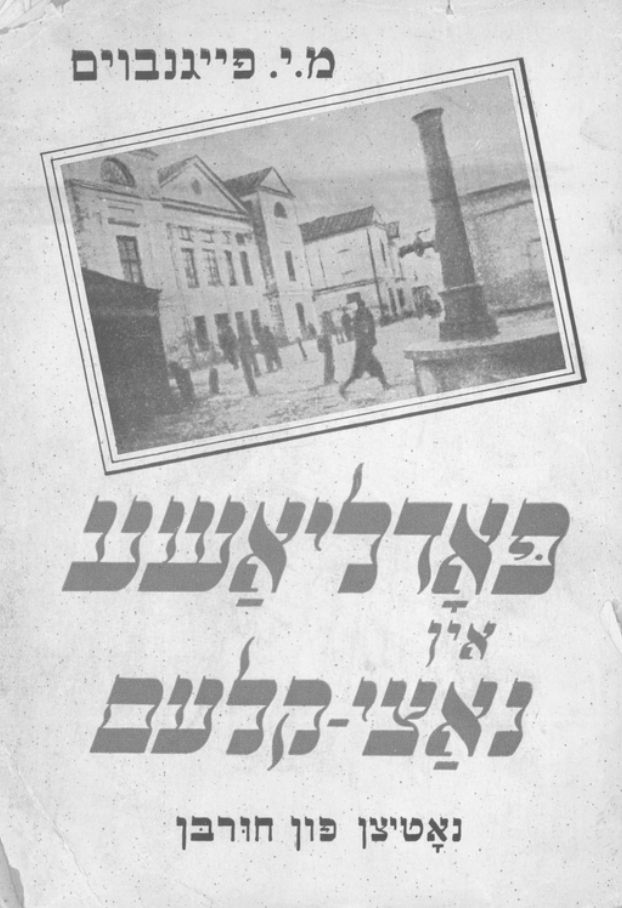
Yizkor (memorial) books document the history of Jewish communities destroyed in the Holocaust. Most often privately published and compiled through the collective efforts of former community residents, they describe daily life through essays and photographs and memorialize murdered residents. Most yizkor books are in Hebrew and/or Yiddish, although more English translations have been published in online and print format. NYPL’s yizkor book collection now includes about 730 yizkor books. A phenomenon for the most part of the late 1950s, the 1960s, and the early 1970s, the yizkor books evoked by the Holocaust were edited, privately printed, and distributed (often free of charge) by committees of survivors of many hundreds of the former Jewish population centers of eastern Europe, and generally they culminate in lists of community members who did not survive the war. Over the centuries, however, traditional yizkor books (or Memorbücher, as they were called in the original Ashkenazi lands of Central Europe) had expanded beyond commemorating only the victims of persecution to record also the outstanding personages who had adorned the community in good times as well as bad. True to this spirit, the activists in the post-war yizkor book revival sought both to commemorate the dead and to recollect and celebrate, as well, the quality of life of the communities of which they had been a part. Where yizkor books contain lists of names, therefore, these are prefaced by personal memoirs and biographical sketches, and much emphasis is placed, too, on essays that describe local Jewish society in all the diversity represented by its organizations: political, intellectual, artistic, professional, and recreational, as well as philanthropic and spiritual. Typically, these books were published in Israel or New York, or, occasionally, in Buenos Aires. The essays in these volumes may be all in Hebrew, or all in Yiddish, or some in one language and some in the other. Not infrequently, a brief English-language summary appears at the end; in a few cases, there may be substantial content in English, Hungarian, or other languages. Holocaust memorial books tend to be long, frequently running to 600-900 pages, and they are unindexed. Many of the volumes are extensively illustrated with photographs, although the images, themselves survivors of the Holocaust, have sometimes suffered damage and the quality of reproduction is not always particularly high, in line with the book production values of the time. Yizkor books were published in very small quantities and at a time when permanent paper was little used. As a result, these volumes, which were meant to perpetuate the memory of a "vanished world," are often hard to find, and, in some cases, are themselves in danger of vanishing. The yizkor book holdings of the Dorot Jewish Division are the most extensive in the United States, with upwards of 90% of the titles listed in Zachary M. Baker's Bibliography of Eastern European Memorial (Yizkor) Books.


Type

Image

Geographical area

Central EuropeSoviet Union

Period

20th centurySoviet UnionWorld War II

Language

HebrewYiddish

Keywords

diarieshistoryholocaustjewsmemory-bookspersonal-memoirsshoah

Published : October 15, 2020

Share this source

Send by email

Share this source by email or save it by sending the data to your mail box.

Newsletter

Receive the latest sources each month

By clicking on the Subscribe button, you confirm that you have read our Data Protection policy.
Logo cnrsLogo ehessLogo cercec

The Online Primary Sources database is curated by
the french Centre for Russian, Caucasian and Central European Studies (CERCEC), a CNRS-EHESS joint research unit.

  • Credits
  • Legal Notice
  • Data Protection