Logo

Online Primary Sources

  • Home
  • All Sources
  • About
  • Newsletter
Filter by
PeriodGeographical areaInstitutionTypeLanguage
  • 11th century (1)
  • 12th century (1)
  • 13th century (1)
  • 14th century (1)
  • 15th century (1)
  • 16th century (1)
  • 17th century (3)
  • 18th century (7)
  • 1917 (1)
  • 19th century (9)
  • 20th century (11)
  • 21st century (2)
  • Imperial Russia (16)
  • Post-Soviet Russia (1)
  • Pre-Revolutionary Period (1)
  • Russian Empire (3)
  • Soviet Union (7)
  • Third Reich (1)
  • World War 1 (1)
  • World War II (2)
  • Antonevskaya (1)
  • Baltic States (1)
  • Barnaul (1)
  • Estonia (1)
  • Imperial Russia (10)
  • Narva (1)
  • Russia (4)
  • Russian Empire (3)
  • Sartakovo (1)
  • Siberia (1)
  • Soviet Republics (1)
  • Soviet Union (4)
  • St-Petersburg (1)
  • Sweden (1)
  • Tomsk Region (1)
  • Worldwide (1)
  • Digital Library Runivers (1)
  • Evgeny Viktorovich Anisimov (1)
  • FEB: Fundamentalnaia Elektronnaia Biblioteka (1)
  • German Humanities Institutes Abroad (1)
  • Higher School of Economics (1)
  • Institute of History of the Siberian Branch of the Russian Academy of Sciences (1)
  • Max Weber Stiftung (MWS) (1)
  • Narva Museum (1)
  • Petrozavodsk State University, Department of Philology (1)
  • Private Initiative (5)
  • Russian State Archives of Literature and Art (RGALI) (1)
  • Russian Tabak Group Media (1)
  • RuStikh (1)
  • St. Petersburg School of Humanities and Arts (1)
  • The “Encyclopedia” Foundation for the Promotion of the Historical and Cultural Heritage of the Jewish People (1)
  • Viacheslav Rumiantsev (1)
  • Audio (1)
  • Image (4)
  • Interactive map (1)
  • Links (2)
  • Transcript (16)
  • Translation (2)
  • Video (1)
  • Russian (16)

16 sources found in the database

for Imperial RussiaTranscript
  • Itinera Petri: Biokhronika Petra Velikogo (1672-1725 gg.) Database


    Evgeny Viktorovich Anisimov

    Higher School of Economics

    St. Petersburg School of Humanities and Arts

  • Online Encyclopedia “Jewish St. Petersburg”


    The “Encyclopedia” Foundation for the Promotion of the Historical and Cultural Heritage of the Jewish People

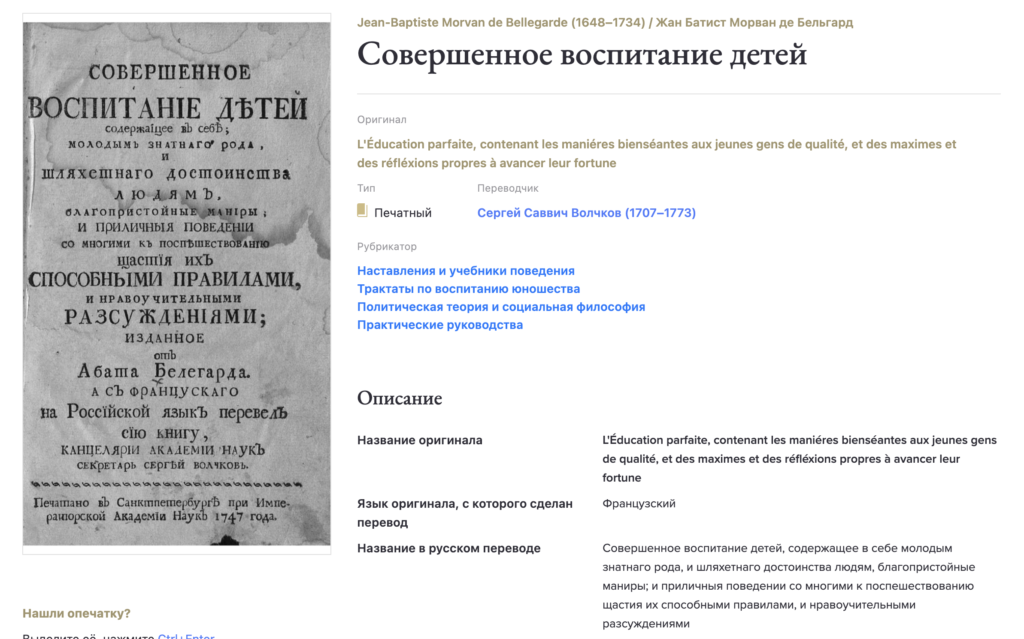
  • Corpus of Russian Translations of European Socio-Political Writings, 18th-19th Century


    German Humanities Institutes Abroad

    Max Weber Stiftung (MWS)

  • "Tabachnyi magazin" Newspaper (2002-today)


    Russian Tabak Group Media

  • Brockhaus and Efron Encyclopaedic Dictionary Online, 1890-1907


    Digital Library Runivers

  • Documents of the XX Century


    Private Initiative

    Viacheslav Rumiantsev

  • Russian Estonia, 19th-21st Century


    Narva Museum

  • Poems of Russian Classics


    RuStikh

  • Full-Text Repository of Russian Literature, 11th-20th Century


    FEB: Fundamentalnaia Elektronnaia Biblioteka

  • General Armorial of Noble Families of the Russian Empire


    Private Initiative

  • M.M. Scherbatov, "O povrezhdenii nravov v Rossii", 1786 or 1787 (Pamphlet)


    Private Initiative

  • Museum and Bibliographic Activities of A.G. Dostoevskaya


    Petrozavodsk State University, Department of Philology

  • «
  • ‹
  • 1
  • 2
  • ›

Corpus of Russian Translations of European Socio-Political Writings, 18th-19th Century


Institution

German Humanities Institutes AbroadMax Weber Stiftung (MWS)

Url

https://krp.mws-osteuropa.org/

About the ProjectAbout the WebsiteProject Team

In Russian history, the 18th century marked a turning point in the development of secular culture. During this era, a new political vocabulary emerged, reflecting a rational understanding of society and the individual. It was in the 18th century that Russian political language first took shape.

The Transfer of Political Ideas in the 18th Century

A project of the German Historical Institute in Moscow investigates the process of transfer, adaptation, and reception of major European political ideas and concepts in 18th-century Russia. The project continues the GHI’s research in the field of the history of concepts (see the project “History of Concepts and Historical Semantics”), particularly in the realm of methodology, but using new source material.

Translation as a Laboratory of Political Ideas

The project’s starting point is the assumption that political terminology in the Russian language emerged through the process of translation, as political concepts acquired their specific meanings within concrete social and political contexts.

The key players in this process are translators, clients commissioning translations, and readers who use and interpret the new political vocabulary, thereby transforming the semantic field of the Russian language.

We are interested not only in the translation of European political terminology into Russian itself, but also in the dissemination and use of printed and manuscript translations of “political” works in 18th-century Russia. One of the project’s most important research objectives is to describe the extensive range of manuscript and printed translated works produced in 18th-century Russia.

What is “political” in the 18th century?

The database contains translations of works that can be attributed to the broad sphere of humanities, which in the 17th–18th centuries was often referred to as “civil science” (scientia civilis), intended to address a member of society (“citizen,” “son of the fatherland,” “man of the state”) about the purpose, history, structure, and mechanisms of governance of “civil society” (societas civilis) and the role of the citizen (civis) himself. The boundaries of the political sphere in the 18th century are difficult to define using modern concepts such as “sociology,” “political science,” “economics,” or “law.” European “political” literature of this era is characterized by the intersection of disciplinary discourses, while maintaining significant close ties between “scientific” and artistic texts. Therefore, a political treatise in this era could be a collection of practical instructions (Machiavelli, Guicciardini, Serriol), a book of graphic emblems with metaphorical descriptions of the “roles” of the sovereign and subjects (Saavedro Fajardo), a political novel (Fénelon), a pamphlet (Boccalini), or a collection of historical examples addressing specific political “cases” (Lipsius, Bessel, Fredro).

Thus, the category of political books in this era includes texts that fall within the scope of modern social philosophy, political theory, history, and economics, as well as individual literary works of a political nature (political novels, pamphlets, journalism, etc.), as well as manuals, reference books, dictionaries, and textbooks that we would now classify under these disciplines.


Type

TranscriptTranslation

Geographical area

Imperial Russia

Period

18th century19th centuryImperial Russia

Language

Russian

Keywords

conceptsdisseminationeuropean-political-ideasideaslaboratory-of-political-ideasnew-political-vocabularypolitical-terminologyreceptiontransfertranslationstranslators

Published : April 22, 2026

Share this source

Send by email

Share this source by email or save it by sending the data to your mail box.

Newsletter

Receive the latest sources each month

By clicking on the Subscribe button, you confirm that you have read our Data Protection policy.
Logo cnrsLogo ehessLogo cercec

The Online Primary Sources database is curated by
the french Centre for Russian, Caucasian and Central European Studies (CERCEC), a CNRS-EHESS joint research unit.

  • Credits
  • Legal Notice
  • Data Protection