
"Soviet Survivors of Nazi Rule: The First Testimonies" Database
After the collapse of the Soviet Union, the transcripts of hundreds of interviews with Soviet survivors of the German occupation were found in Russian, Ukrainian and Belarusian archives. These transcripts were created by a Moscow commission headed by the historian Isaak Izrailevich Mints. Shortly after the German invasion of the Soviet Union, Mints set himself and his co-workers the goal of comprehensively documenting his country’s “Great Patriotic War”. He practiced a form of oral history that was ahead of its time and is still relevant today. The life stories of Soviet war participants - soldiers and civilians, men and women - formed the core of his documentary work
The commission paid particular attention to the fate of Soviet citizens under German rule. Following the recapture of Soviet towns and villages by the Red Army, Minz sent small teams of historians and stenographers to the destroyed villages and towns, where they spoke with survivors. After the liberation of the Ukrainian and Belorussian Soviet republics, partner commissions were formed in Kiev and Minsk, which carried out numerous further interviews with survivors, following the example of Mints’s Moscow commission.
These Soviet eyewitness accounts add a critical dimension to the memory of the Holocaust and the Second World War. The mass murder of millions of Jews in Europe, including the Soviet Union, is now better researched thanks to recent projects such as “Holocaust by Bullets” by Patrick Desbois or “Untold Stories”, Yad Vashem’s exploration of the murder sites of Soviet Jews. Less is known about the wider context of Nazi policies of exploitation and oppression. In addition to 2.6 million Soviet Jews, Germany’s war of extermination against the Soviet Union cost the lives of millions of prisoners of war, communists, partisans and forced laborers. Now that the chorus of voices of Soviet survivors is finding its way into historical memory, it expands traditional narratives about Nazi aggression and extermination, endowing them with a distinct Soviet accent.
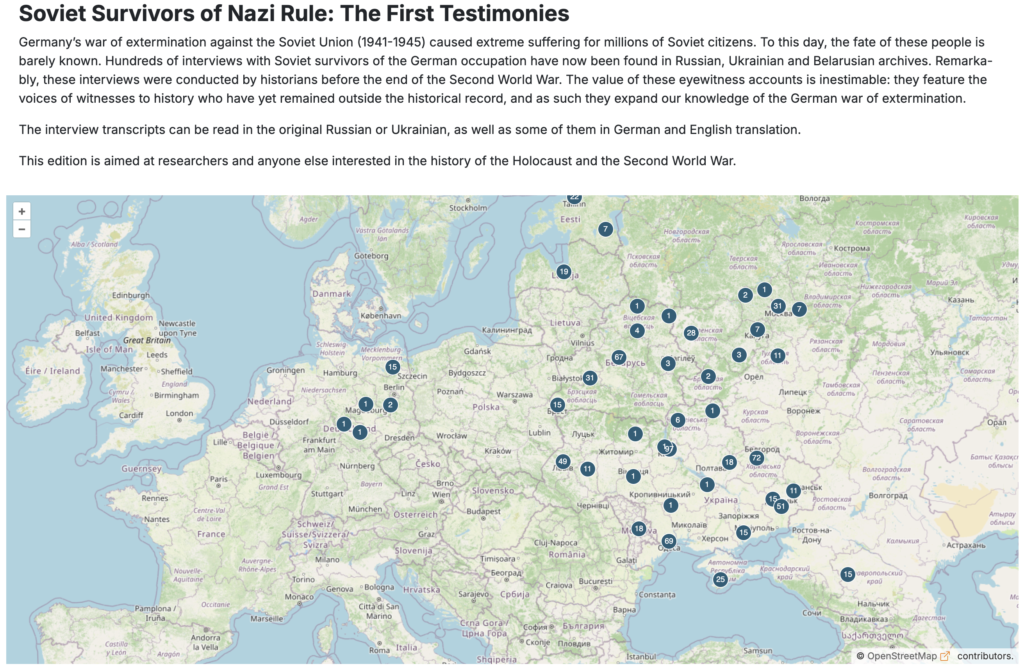
Germany’s war of extermination against the Soviet Union (1941-1945) caused extreme suffering for millions of Soviet citizens. To this day, the fate of these people is barely known. Hundreds of interviews with Soviet survivors of the German occupation have now been found in Russian, Ukrainian and Belarusian archives. Remarkably, these interviews were conducted by historians before the end of the Second World War. The value of these eyewitness accounts is inestimable: they feature the voices of witnesses to history who have yet remained outside the historical record, and as such they expand our knowledge of the German war of extermination.
The interview transcripts can be read in the original Russian or Ukrainian, as well as some of them in German and English translation.
This edition is aimed at researchers and anyone else interested in the history of the Holocaust and the Second World War.
Keywords
Published : April 22, 2026