Logo

Online Primary Sources

  • Home
  • All Sources
  • About
  • Newsletter
Filter by
PeriodGeographical areaInstitutionTypeLanguage
  • 1930s (2)
  • 1940s (1)
  • 1950s (1)
  • 20th century (5)
  • 21st century (1)
  • Fascist Italy (1)
  • Great Patriotic War (1)
  • Nazi Germany (8)
  • Russia's war against Ukraine (1)
  • Soviet Ukraine (1)
  • Soviet Union (5)
  • Stalinist Era (1)
  • World War II (7)
  • Czechoslovakia (1)
  • Eastern Europe (1)
  • German Reich (1)
  • Germany (1)
  • Nazi Germany (3)
  • Poland (2)
  • Russia (1)
  • Shostka (1)
  • Soviet Russia (1)
  • Soviet Union (4)
  • Sumy Region (1)
  • Theresienstadt (1)
  • Ukraine (3)
  • Anna Nevzlin, historian and researcher of 20th-century Jewish history (1)
  • Blavatnik Archive (1)
  • Dekoder.org (1)
  • Jewish Museum in Prague (1)
  • Kysylyn Museum (1)
  • Museum “Family Memory” (Rodinna Pamiat) (1)
  • National Archive of Lodz (1)
  • Private Initiative (1)
  • Image (8)
  • Listing (1)
  • Transcript (3)
  • Translation (1)
  • Video (2)
  • Czech (1)
  • English (3)
  • German (2)
  • Polish (1)
  • Russian (3)
  • Ukrainian (3)

8 sources found in the database

for Nazi GermanyImage
  • E. Stasova, "Edinyi front zhenshchin protiv voiny i fashizma / United front of women against war and fascism", 1934 (Booklet)


    Blavatnik Archive

  • "Jewish Heroes / Evreiskie Geroi" - Project about Jews Who Have Performed Heroic Deeds


    Anna Nevzlin, historian and researcher of 20th-century Jewish history

  • “East”. Soviet Forced Laborers in the German Reich


    Dekoder.org

  • Files of the German Administration of the Łódź Ghetto, 1939-1945


    National Archive of Lodz

  • "After Silence" Ukrainian Project


    Private Initiative

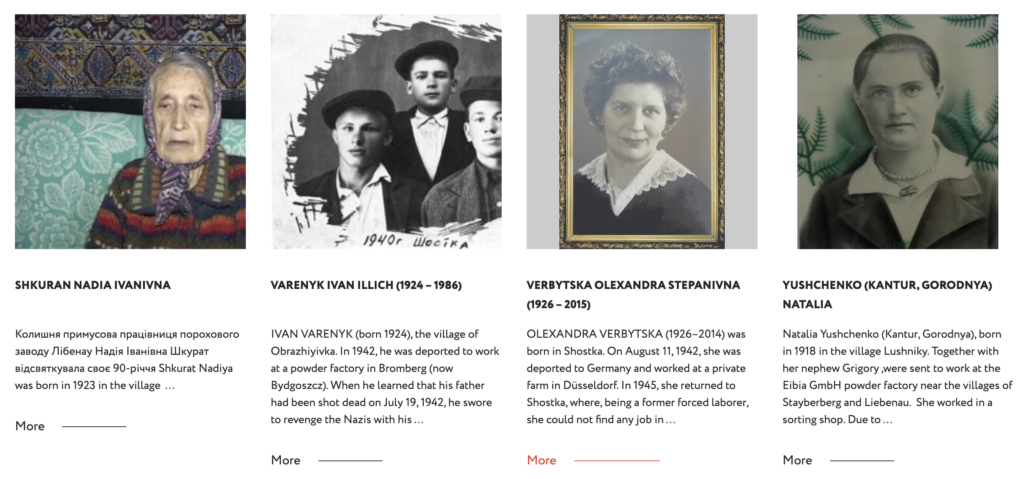
  • Museum of the Deportation of Residents of Shostka City and District to Forced Labor Duty


    Museum “Family Memory” (Rodinna Pamiat)

  • The Terezín Collection


    Jewish Museum in Prague

  • Online Exhibition “Letters from Ostarbeiters on the Outskirts of Kysylyn”


    Kysylyn Museum

  • «
  • ‹
  • 1
  • ›

Museum of the Deportation of Residents of Shostka City and District to Forced Labor Duty


Institution

Museum “Family Memory” (Rodinna Pamiat)

Url

https://shostkamuseum.com.ua/en/

One of the most popular measures of the occupation authorities that affected almost every family was deportation to do forced labor in Nazi Germany and countries occupied by it. Deportation of Shostka region locals began in early April 1942 and lasted until the end of the summer of 1943, the very retreat of the German army. According to post-war calculations, 1,815 locals were taken out of the villages of Shostka district and 6,000 young men and women were taken out of the Shostka city.

Deportation exposition shows samples of labor exchange reports received from families of young people. An inconspicuous document – a letter from the recruitment commission to the chief of police of the city of Shostka, asking him to hand over the summons to an addressee – explains how thousands of people were gathered to be sent out.

While in 1942, it was mostly young people who were sent to Germany, but in 1943, entire families were deported: neither young children nor sick parents presented any barriers to the Nazis. A memo from the First Lieutenant of the Kupper Security Police on escorting a train with forced workers to Germany, tells us a lot about the methods of exporting labor force to the Reich and the circumstances of their transportation. The history of the Bunny family and the Sedachev sisters who were deported to do forced labor with their young children, is a prime example of this occupational policy.


Type

ImageListingVideo

Geographical area

ShostkaSoviet UnionSumy RegionUkraine

Period

Great Patriotic WarNazi GermanySoviet UnionWorld War II

Language

EnglishUkrainian

Keywords

biographiesdeportationdocumentsfiltration-casesforced-laborinvestigation-cases-of-nkvd-mgblettersnazi-occupationnewspapersoral-historyostarbeiterspersonal-documentswitnesses

Published : June 27, 2025

Share this source

Send by email

Share this source by email or save it by sending the data to your mail box.

Newsletter

Receive the latest sources each month

By clicking on the Subscribe button, you confirm that you have read our Data Protection policy.
Logo cnrsLogo ehessLogo cercec

The Online Primary Sources database is curated by
the french Centre for Russian, Caucasian and Central European Studies (CERCEC), a CNRS-EHESS joint research unit.

  • Credits
  • Legal Notice
  • Data Protection