Logo

Online Primary Sources

  • Home
  • All Sources
  • About
  • Newsletter
Filter by
PeriodGeographical areaInstitutionTypeLanguage
  • 13th century (1)
  • 14th century (1)
  • 15th century (1)
  • 16th century (1)
  • 17th century (1)
  • 18th century (1)
  • 19-21 August 1991 (1)
  • 1930s (1)
  • 1940s (1)
  • 1950s (1)
  • 1960s (1)
  • 19th century (2)
  • 20th century (11)
  • 21st century (1)
  • Cold War (1)
  • Imperial Russia (1)
  • Ottoman Empire (1)
  • Pre-Revolutionary Period (1)
  • Revolution (1)
  • Soviet Union (11)
  • World War 1 (1)
  • World War II (1)
  • Afghanistan (1)
  • Armenia (1)
  • Austria (1)
  • Caucasus (1)
  • Central Asia (1)
  • Crimea (1)
  • Eastern Europe (1)
  • Eurasia (1)
  • France (3)
  • Great Britain (1)
  • Hungary (1)
  • Kazakhstan (1)
  • Moscow (1)
  • Novorossiysk (1)
  • Poland (1)
  • Post-Soviet Republics (1)
  • Post-Soviet Russia (1)
  • Russia (5)
  • Russian Empire (1)
  • Siberia (2)
  • Soviet Union (7)
  • Ukraine (3)
  • USA (1)
  • Bibliothèques et archives nationales du Québec (1)
  • Centre Alexandre Koyré, CNRS (1)
  • Ecole des Hautes Etudes en Sciences Sociales (EHESS) (1)
  • HayBook (1)
  • Institut National d'Etudes démographiques (INED) (1)
  • Institute of Slavic Studies, Paris (1)
  • John Earl Haynes, Harvey Klehr & Steven Usdin (1)
  • Ministère de l'Europe et des Affaires Etrangères (1)
  • Nekrasov Library (1)
  • Private Initiative (1)
  • Radio France Internationale (RFI) (1)
  • Russian National Library (1)
  • theatre-russe.info (1)
  • Vera and Donald Blinken Open Society Archives (1)
  • Audio (1)
  • E-book (1)
  • Image (4)
  • Pdf (5)
  • Transcript (2)
  • Video (3)
  • Zip-File (1)
  • Armenian (1)
  • Bulgarian (1)
  • English (3)
  • French (11)
  • German (1)
  • Hungarian (1)
  • Polish (2)
  • Romanian (1)
  • Russian (6)
  • Slovak (1)

11 sources found in the database

for 20th centurySoviet UnionFrench
  • Friday: A Searchable Archive of Declassified Cold War Documents on Soviet Espionage


    John Earl Haynes, Harvey Klehr & Steven Usdin

    Private Initiative

  • “Mon URSS / My USSR" - Collection of Memories from Teachers & Researchers of the Institute of Slavic Studies in Paris


    Institute of Slavic Studies, Paris

  • "Eurasia by Bike" - Lucien Péraire's (1906-1997) Bicycle Journey Across Eurasia


    Centre Alexandre Koyré, CNRS

  • The 1991 Moscow Putsch in the Online French Diplomatic Archives


    Ministère de l'Europe et des Affaires Etrangères

  • Collection of 700 Films Produced in Post-Soviet Republics Between 2000 and 2022


    theatre-russe.info

  • The Famine in Russia, 1933 (Booklet)


    Bibliothèques et archives nationales du Québec

  • Armenian Ebooks


    HayBook

  • Russkii khudozhestvennyi farfor, 1924 (Book)


    Nekrasov Library

  • Newspapers of Parties and Public Organizations from Russia & Abroad (19th-20th Centuries)


    Russian National Library

  • SOUND ARCHIVES European Memories of the Gulag


    Ecole des Hautes Etudes en Sciences Sociales (EHESS)

    Institut National d'Etudes démographiques (INED)

    Radio France Internationale (RFI)

  • Soviet Propaganda Film Collection


    Vera and Donald Blinken Open Society Archives

  • «
  • ‹
  • 1
  • ›

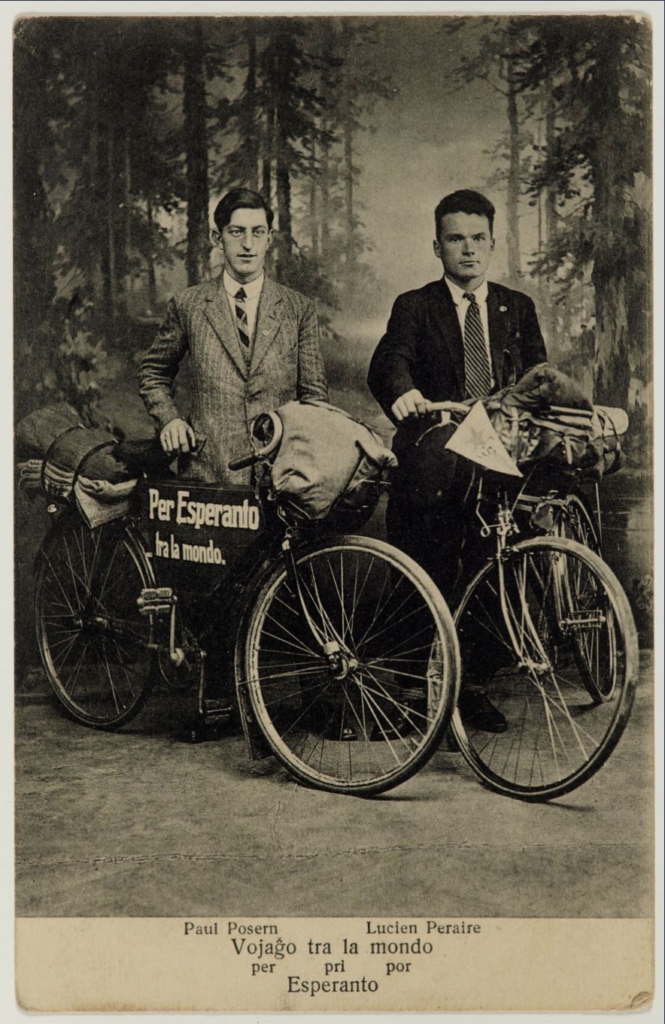
"Eurasia by Bike" - Lucien Péraire's (1906-1997) Bicycle Journey Across Eurasia


Institution

Centre Alexandre Koyré, CNRS

Url

https://peraire.huma-num.fr/fr/index.php

Eurasia by bicycle
Between 1928 and 1932, Esperanto worker Lucien Péraire (1906-1997) embarked on a bicycle journey across Europe, the USSR, Manchuria, Japan, China and Indochina as far as Java. Initiated in the wake of the First World War and the trauma it inflicted on his generation, the journey was part of his desire to understand the causes of enmity between nations, and to demonstrate that a transnational community of solidarity is possible through the worldwide network of Esperantists. [...]

Crossing Europe on borrowed time
The journey begins through Austria, Hungary, Poland and the Crimea to Novorossiysk on the Black Sea, which they reach in the middle of winter. They often stayed with Esperantists, who solved many practical and bureaucratic problems. In many places - even the most isolated - they meet samideanoj, with whom they share not only the language but also a certain vision of the world. Many of them accompany them by bike for a few days or weeks. In Crimea, they receive help from the children of a kolkhoz, who learn Esperanto from an itinerant teacher. The cycling companions modestly finance their lives by selling postcards about their expedition and organizing evening talks and songs. Paul and Lucien obtain their Soviet visas in Poland and enter the country by rail, according to customs rules, on an almost empty train. In Ukraine, “the stigma of the recent civil war is ever-present: houses with leprous facades, or half-demolished. An indefinable discomfort hangs over everything”. As they left the Soviet Ukraine, a major obstacle awaited them: in Russia, the roads disappeared and were replaced by muddy pavements. The journey slows down.

The USSR, hopes and disappointments
During the winter, in Novorossisk or Irkutsk, Lucien works in the factory. Political activities punctuated his work. In December 1928, Paul and Lucien decided to separate. Paul continued on to Baku, hoping to pass southwards through Persia and India, but, lacking a visa, he eventually turned back through North Africa, and reached Europe via Spain. Lucien decided to take the northern route, across Siberia to Asia. To make progress in the absence of passable roads, he designs and builds a bicycle in Kazan that allows him to ride on the Trans-Siberian railway. With the support of his Esperantist friends, and after several visits to Moscow, he obtained authorization to use this original means of transport. [...}


Type

ImagePdf

Geographical area

AustriaCrimeaEurasiaHungaryNovorossiyskPolandUkraine

Period

20th centurySoviet Union

Language

French

Keywords

asiabicycleesperantojourneyussr

Published : January 07, 2025

Share this source

Send by email

Share this source by email or save it by sending the data to your mail box.

Newsletter

Receive the latest sources each month

By clicking on the Subscribe button, you confirm that you have read our Data Protection policy.
Logo cnrsLogo ehessLogo cercec

The Online Primary Sources database is curated by
the french Centre for Russian, Caucasian and Central European Studies (CERCEC), a CNRS-EHESS joint research unit.

  • Credits
  • Legal Notice
  • Data Protection