
Archives of Repression: Personal Letters in ex-KGB Archives in Kyiv, 1938-1947
Institution
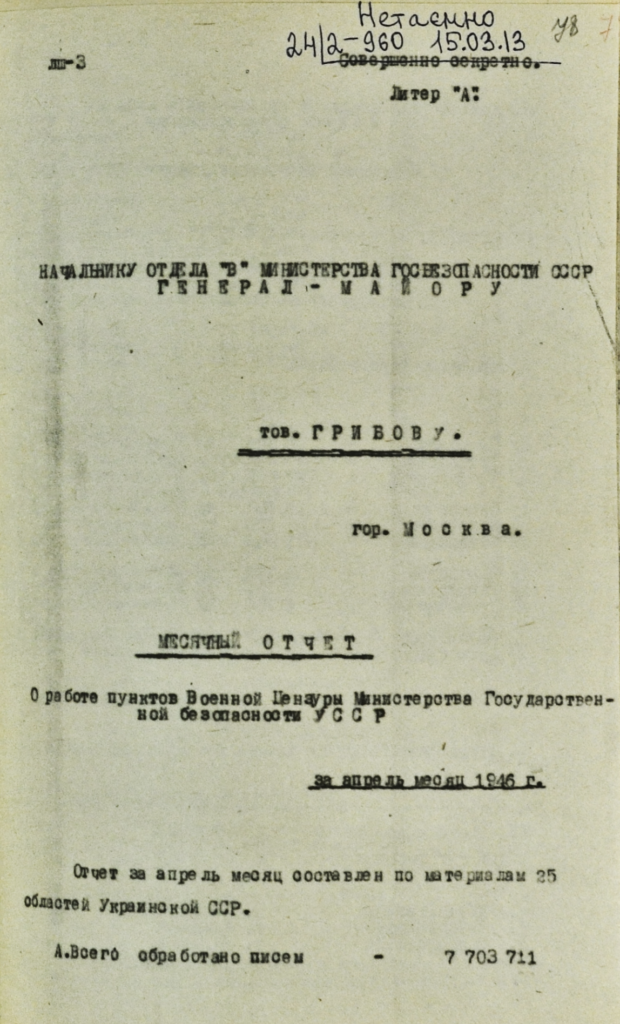
Between 1938 and 1947, two different postal control systems were practiced by the Soviet security services: military censorship and the so-called “PK”. Military censorship existed between 1940 and 1946: it was introduced after the Finnish-Soviet war broke out in 1939 and cancelled in 1946 after the end of WW2. After 1946 it continued to monitor the correspondence of military personnel. Military censorship was catchall (applied to all correspondence), it was also open (overt) and after monitoring every letter was marked with a special stamp. “PK” (standing for “political control” and often also referred to as “perlustration”) was secret (covert) and selective. Every month each postal control site, be it military censorship or “PK”, confiscated thousands of letters. The confiscated letters were kept only for a few months, after that, they were destroyed. A scholar interested in postal control of private correspondence and working at the ex-KGB archives typically has access to censorship instructions, “monthly reports”, “special reports”, and “special summaries”. Monthly reports were compiled by the head office of security services (in our case, the NKGB and later the MGB of the Ukrainian SSR) reporting to the head office in Moscow. The monthly reports typically contained numerous excerpts from letters subject to confiscation in Russian translation. Special reports were usually dedicated to one or a chain of confiscated letters, they contained excerpts from confiscated letters in Russian translation, or, in some cases, full letters in translation or original. Special summaries reported on particular themes, e.g. “On the facts of response to fascist aggression” (1938) or “On persons who cohabited [had intercourse] with the German occupiers” (1944). This webpage provides access to a selection of documents from each group housed at HDA SBU.
One of the practical goals of “Trapped in Archives of Repression: Personal Letters in ex-KGB Archives” was to assist in providing online access to the documents housed in Sectoral State Archive of Security Service of Ukraine (Галузевий державний архів Служби безпеки України, HDA SBU) and related to the postal censorship of private correspondence in the USSR. On this webpage, we publish documents collected during a 4-year work on the project.
For all documents, the originals (pdf files) are provided. We also provide transcripts and English translations for the majority of these documents. The translations were created at different project stages and with different purposes; they range from fully prepared for publication to interlinear translations. All the translations are true to the originals and could be used to access the content of the documents published on this webpage.
Keywords
Published : September 04, 2024