Logo

Online Primary Sources

  • Home
  • All Sources
  • About
  • Newsletter
Filter by
PeriodGeographical areaInstitutionTypeLanguage
  • 1941-1945 (1)
  • 19th century (1)
  • 20th century (2)
  • Holocaust (1)
  • World War II (2)
  • Austria (1)
  • Belgium (1)
  • Canada (1)
  • Croatia (1)
  • Europe (1)
  • France (1)
  • Ireland (1)
  • Israel (1)
  • Italy (1)
  • Latvia (3)
  • Riga (1)
  • United Kingdom (1)
  • USA (1)
  • Latvian Institute of Literature, Folklore and Art (LU LFMI) (1)
  • National Archives of Latvia (1)
  • The World Federation of Free Latvians (1)
  • Žanis Lipke Memorial (1)
  • Database (1)
  • Image (1)
  • Interactive map (3)
  • Transcript (1)
  • English (1)
  • Latvian (3)

3 sources found in the database

for Interactive mapLatvian
  • "The Representation of Women in Latvian Culture and Society (1870–1940)" Project


    Latvian Institute of Literature, Folklore and Art (LU LFMI)

  • Underground Riga - Urban Topography Project on Spaces Where Jews Were Rescued during WWII


    Žanis Lipke Memorial

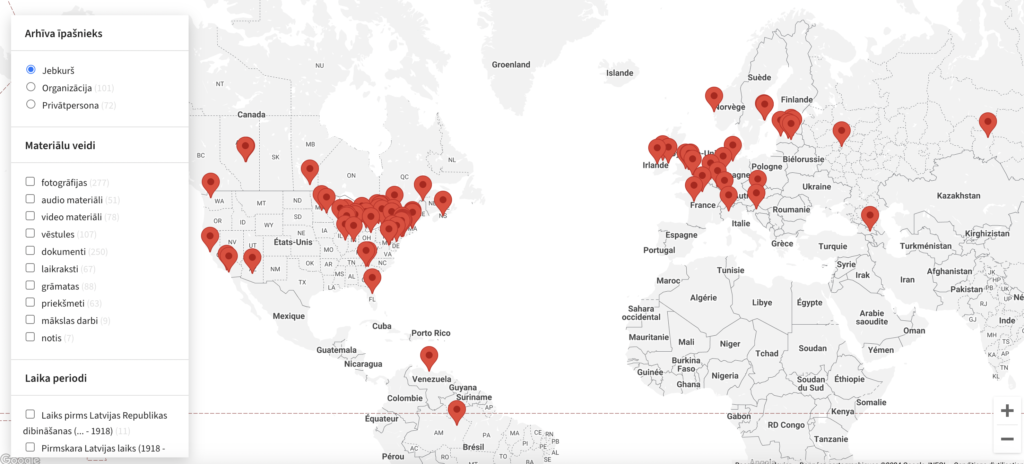
  • Interactive Map of the Location of Latvian Diaspora Archives Outside Latvia


    National Archives of Latvia

    The World Federation of Free Latvians

  • «
  • ‹
  • 1
  • ›

Interactive Map of the Location of Latvian Diaspora Archives Outside Latvia


Institution

National Archives of LatviaThe World Federation of Free Latvians

Url

https://arhivi.pbla.lv/

Location of Latvian diaspora archives outside Latvia


Type

Interactive map

Geographical area

AustriaBelgiumCanadaCroatiaEuropeFranceIrelandIsraelItalyLatviaUnited KingdomUSA

Period

20th centuryWorld War II

Language

Latvian

Keywords

mappersonal-archives

Published : February 15, 2024

Share this source

Send by email

Share this source by email or save it by sending the data to your mail box.

Newsletter

Receive the latest sources each month

By clicking on the Subscribe button, you confirm that you have read our Data Protection policy.
Logo cnrsLogo ehessLogo cercec

The Online Primary Sources database is curated by
the french Centre for Russian, Caucasian and Central European Studies (CERCEC), a CNRS-EHESS joint research unit.

  • Credits
  • Legal Notice
  • Data Protection