Logo

Online Primary Sources

  • Home
  • All Sources
  • About
  • Newsletter
Filter by
PeriodGeographical areaInstitutionTypeLanguage
  • 1900 (2)
  • 1910s (6)
  • 1920s (3)
  • 1930s (3)
  • 20th century (6)
  • 21st century (1)
  • Imperial Russia (2)
  • Post-Soviet Lithuania (1)
  • Soviet Ukraine (1)
  • Far East (1)
  • Georgia (1)
  • Hungary (1)
  • Kharkiv (1)
  • Lithuania (1)
  • Moldova (1)
  • Romania (1)
  • Siberia (1)
  • Slovakia (1)
  • Soviet Union (1)
  • Tbilisi Gubernia (1)
  • Transcarpathia (1)
  • Ukraine (2)
  • Vilnius (1)
  • Archives of Historical and Ethnographic Yiddish Memories (AHEYM) (1)
  • Central Historical Archive, National Archives of Georgia (1)
  • Digital Library Runivers (1)
  • International Institute of Social History (1)
  • issuu.com (1)
  • V. G. Korolenko Kharkiv State Scientific Library (1)
  • E-book (1)
  • Image (3)
  • Listing (1)
  • Pdf (1)
  • Video (1)
  • English (2)
  • Georgian (1)
  • Russian (3)
  • Ukrainian (1)
  • Yiddish (1)

6 sources found in the database

for 1910s
  • Fund of the Gendarmerie Office of Tbilisi Governorate, 1904-1917


    Central Historical Archive, National Archives of Georgia

  • Yiddish Language Interviews with People Born Between the 1900s and the 1930s


    Archives of Historical and Ethnographic Yiddish Memories (AHEYM)

  • Vilnius 1910-2013. A Guide to the City's Architecture (Book)


    issuu.com

  • Collection of Soviet Posters, 1910s-1920s-1930s


    International Institute of Social History

  • Electronic Collection of Literary and Artistic Magazines of Kharkiv of the First Third of the Twentieth Century


    V. G. Korolenko Kharkiv State Scientific Library

  • Aziatskaia Rossiia, 4 volumes, 1914 (Book)


    Digital Library Runivers

  • «
  • ‹
  • 1
  • ›

Collection of Soviet Posters, 1910s-1920s-1930s


Institution

International Institute of Social History

Url

https://www.iisg.nl/exhibitions/chairman/sovintro.php

With the Russian Revolution of 1917, for the first time in history an entire nation is governed by a communist system. The posters from the first years of this government show revolutionary zeal and optimism of building a new society. Campaigns are waged to eliminate illiteracy and improve health care. Other posters attack the opponents of Lenin's government: a bloody civil war swept the country until 1920. Progressive artists use the poster as a medium to reach a broad public. As far as style is concerned, they do not have to cope with artistic directives yet.

By 1930, Stalin is in full control. Propaganda focuses on political discipline and the Five Year Plans, ambitious programs for the collectivization of agriculture and establishment of heavy industry. The posters give a powerful, dynamic impression, using photomontage, compositions with diagonal lines, and strong contrasts in colours and shapes.

In the 1930s, this Constructivist style falls from grace. Critics claim it is unrealistic, too difficult to comprehend, and too individualistic. Constructivist designers experience great difficulties; only Socialist Realism is approved. Happy, healthy, young workers and determined soldiers are the principal subjects, as well as, of course, the friendly smiling Stalin.


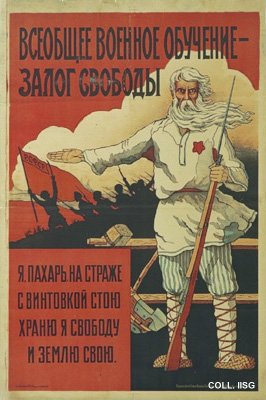
[Illustration : Designer unknown, 1919. A general military training is a safeguard for freedom. Publisher: Vsebovuch, Moscow. (Lithography, 110.5x74.5 cm., inv.nr. BG L3/210)
In the years following 1917, the Soviet Union is torn by a bloody civil war between the 'Reds' (the communists) and the 'Whites'. This poster calls for the farmers to fight on the side of the Reds.


Type

Image

Geographical area

Soviet Union

Period

1910s1920s1930s20th century

Language

EnglishRussian

Keywords

agriculturecivil-warcollectivizationconstructivist-designersdisciplinefive-year-planshealth-careilliteracyindustryphotomontageposterspropagandarevolution

Published : February 02, 2024

Share this source

Send by email

Share this source by email or save it by sending the data to your mail box.

Newsletter

Receive the latest sources each month

By clicking on the Subscribe button, you confirm that you have read our Data Protection policy.
Logo cnrsLogo ehessLogo cercec

The Online Primary Sources database is curated by
the french Centre for Russian, Caucasian and Central European Studies (CERCEC), a CNRS-EHESS joint research unit.

  • Credits
  • Legal Notice
  • Data Protection