Logo

Online Primary Sources

  • Home
  • All Sources
  • About
  • Newsletter
Filter by
PeriodGeographical areaInstitutionTypeLanguage
  • 1910s (1)
  • 1920s (7)
  • 1930s (14)
  • 1940s (2)
  • 1950s (2)
  • 1960s (1)
  • 20th century (13)
  • 21st century (1)
  • Cold War (1)
  • Imperial Russia (1)
  • Interwar Period (1)
  • Nazi Germany (1)
  • Post World War II (1)
  • Prewar Years (1)
  • Russia's war against Ukraine (1)
  • Soviet Ukraine (2)
  • Soviet Union (8)
  • Stalinist Era (1)
  • Stalinist Terror (1)
  • World War II (2)
  • Armenia (1)
  • Berlin (1)
  • Central Asia (1)
  • Czechoslovakia (1)
  • Eastern Europe (1)
  • Germany (2)
  • Great Britain (1)
  • Greece (1)
  • Kazakhstan (2)
  • Kharkiv (3)
  • Leningrad (1)
  • Moscow (1)
  • Nazi Germany (1)
  • Poland (1)
  • Republic of Karakalpakstan (1)
  • Russia (2)
  • Shevchenkivskyi District of Kharkiv. (1)
  • Soviet Union (7)
  • Switzerland (1)
  • Syria (1)
  • Ukraine (6)
  • USA (1)
  • Uzbekistan (1)
  • A. Kasteev State Museum of Art of the Republic of Kazakhstan (1)
  • Henkin Brothers Archive Association (1)
  • Holodomor Photo Directory, HREC, Canada (1)
  • International Institute of Social History (1)
  • John Earl Haynes, Harvey Klehr & Steven Usdin (1)
  • National Library of Wales (1)
  • Private Initiative (6)
  • State Museum of Arts of the Republic of Karakalpakstan named after I. V. Savitsky (1)
  • The Magnes Collection at the University of California (1)
  • United Nations Library & Archive (1)
  • 3D model (1)
  • Image (12)
  • Interactive map (1)
  • Pdf (2)
  • Timeline (1)
  • Transcript (3)
  • Translation (2)
  • Video (1)
  • Zip-File (1)
  • Czech (2)
  • English (14)
  • French (2)
  • German (1)
  • Kazakh (1)
  • Russian (6)
  • Ukrainian (4)

14 sources found in the database

for 1930sEnglish
  • "Budinok Slovo / The 'Word' Residential Building" for Ukrainian’s Brightest Writers, Poets, Artists and Theatre Directors, 1928-1938


    Private Initiative

  • Friday: A Searchable Archive of Declassified Cold War Documents on Soviet Espionage


    John Earl Haynes, Harvey Klehr & Steven Usdin

    Private Initiative

  • "Constructivism.Kharkiv" Project - Exploring the Architectural Avant-Garde Heritage of Kharkiv (the 1920s – 1930s)


    Private Initiative

  • Collection of Kazakh Paintings from the 1920s and 1930s


    A. Kasteev State Museum of Art of the Republic of Kazakhstan

  • "After Silence" Ukrainian Project


    Private Initiative

  • The Settlement of Armenian Refugees in UN Archives, 1923-1939


    United Nations Library & Archive

  • Gareth Vaughan Jones Diaries on Soviet Famine in Kazakhstan and Ukraine


    National Library of Wales

  • Collection of Soviet Posters, 1910s-1920s-1930s


    International Institute of Social History

  • Roman Vishniac Photo Collection of Prewar Years Jewish Life in Central Europe


    The Magnes Collection at the University of California

  • SLOVO HOUSE, Kharkiv - Story of the House and its habitants


    Private Initiative

  • Nikolai Bokan Holodomor Photo Collection


    Holodomor Photo Directory, HREC, Canada

  • Henkin Brothers Photo Collection


    Henkin Brothers Archive Association

  • «
  • ‹
  • 1
  • 2
  • ›

Collection of Soviet Posters, 1910s-1920s-1930s


Institution

International Institute of Social History

Url

https://www.iisg.nl/exhibitions/chairman/sovintro.php

With the Russian Revolution of 1917, for the first time in history an entire nation is governed by a communist system. The posters from the first years of this government show revolutionary zeal and optimism of building a new society. Campaigns are waged to eliminate illiteracy and improve health care. Other posters attack the opponents of Lenin's government: a bloody civil war swept the country until 1920. Progressive artists use the poster as a medium to reach a broad public. As far as style is concerned, they do not have to cope with artistic directives yet.

By 1930, Stalin is in full control. Propaganda focuses on political discipline and the Five Year Plans, ambitious programs for the collectivization of agriculture and establishment of heavy industry. The posters give a powerful, dynamic impression, using photomontage, compositions with diagonal lines, and strong contrasts in colours and shapes.

In the 1930s, this Constructivist style falls from grace. Critics claim it is unrealistic, too difficult to comprehend, and too individualistic. Constructivist designers experience great difficulties; only Socialist Realism is approved. Happy, healthy, young workers and determined soldiers are the principal subjects, as well as, of course, the friendly smiling Stalin.


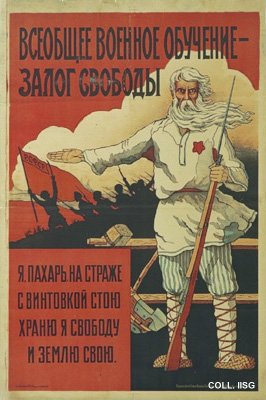
[Illustration : Designer unknown, 1919. A general military training is a safeguard for freedom. Publisher: Vsebovuch, Moscow. (Lithography, 110.5x74.5 cm., inv.nr. BG L3/210)
In the years following 1917, the Soviet Union is torn by a bloody civil war between the 'Reds' (the communists) and the 'Whites'. This poster calls for the farmers to fight on the side of the Reds.


Type

Image

Geographical area

Soviet Union

Period

1910s1920s1930s20th century

Language

EnglishRussian

Keywords

agriculturecivil-warcollectivizationconstructivist-designersdisciplinefive-year-planshealth-careilliteracyindustryphotomontageposterspropagandarevolution

Published : February 02, 2024

Share this source

Send by email

Share this source by email or save it by sending the data to your mail box.

Newsletter

Receive the latest sources each month

By clicking on the Subscribe button, you confirm that you have read our Data Protection policy.
Logo cnrsLogo ehessLogo cercec

The Online Primary Sources database is curated by
the french Centre for Russian, Caucasian and Central European Studies (CERCEC), a CNRS-EHESS joint research unit.

  • Credits
  • Legal Notice
  • Data Protection