Logo

Online Primary Sources

  • Home
  • All Sources
  • About
  • Newsletter
Filter by
PeriodGeographical areaInstitutionTypeLanguage
  • 1910s (1)
  • 1917 (1)
  • 1920s (16)
  • 1930s (7)
  • 20th century (15)
  • Armenian genocide (1)
  • Civil War (1)
  • Imperial Russia (1)
  • Interwar Period (2)
  • Ottoman Empire (1)
  • Post World War II (1)
  • Revolution (1)
  • Soviet Ukraine (1)
  • Soviet Union (5)
  • Stalinist Era (1)
  • Stalinist Terror (1)
  • World War 1 (1)
  • Anatolia (1)
  • Armenia (2)
  • Austro-Hungarian Empire (1)
  • Bielorussia (1)
  • Caucasus (1)
  • Central Asia (1)
  • Crimea (1)
  • Eastern Europe (1)
  • Galicia (1)
  • Germany (1)
  • Greece (1)
  • Hungary (1)
  • Kazakhstan (1)
  • Kharkiv (3)
  • North Caucasus (1)
  • Ottoman Empire (1)
  • Republic of Karakalpakstan (1)
  • Russia (2)
  • Shevchenkivskyi District of Kharkiv. (1)
  • Siberia (1)
  • Soviet Union (9)
  • Switzerland (1)
  • Syria (1)
  • Turkey (1)
  • Ukraine (6)
  • Uzbekistan (1)
  • A. Kasteev State Museum of Art of the Republic of Kazakhstan (1)
  • American Jewish Joint Distribution Committee (JDC) Archives (2)
  • Archive.org (1)
  • Center for Jewish History (1)
  • Dovzhenko Center (1)
  • International Institute of Social History (1)
  • Joint Distribution Committee Archives (2)
  • Near East Relief Historical Society (1)
  • Online Archive of California (OAC) (1)
  • Private Initiative (3)
  • State Museum of Arts of the Republic of Karakalpakstan named after I. V. Savitsky (1)
  • United Nations Library & Archive (1)
  • 3D model (1)
  • E-book (1)
  • Image (10)
  • Interactive map (1)
  • Listing (1)
  • Pdf (5)
  • Timeline (1)
  • Transcript (1)
  • Translation (1)
  • Czech (2)
  • English (16)
  • German (1)
  • Kazakh (1)
  • Russian (2)
  • Ukrainian (3)

16 sources found in the database

for 1920sEnglish
  • "Budinok Slovo / The 'Word' Residential Building" for Ukrainian’s Brightest Writers, Poets, Artists and Theatre Directors, 1928-1938


    Private Initiative

  • "Constructivism.Kharkiv" Project - Exploring the Architectural Avant-Garde Heritage of Kharkiv (the 1920s – 1930s)


    Private Initiative

  • Near East Relief Weekly Bulletin (1920-1922)


    Near East Relief Historical Society

  • American Relief Administration Russian Operational Records, 1919-1925


    Online Archive of California (OAC)

  • Collection of Kazakh Paintings from the 1920s and 1930s


    A. Kasteev State Museum of Art of the Republic of Kazakhstan

  • The Settlement of Armenian Refugees in UN Archives, 1923-1939


    United Nations Library & Archive

  • Boris Pilnyak, The Naked Year, 1922 (Book)


    Archive.org

  • Collection of Soviet Posters, 1910s-1920s-1930s


    International Institute of Social History

  • Album "On the Jewish Fields of the Ukraine" (1926) with illustrations by the Russian French painter Issachar Ryback


    American Jewish Joint Distribution Committee (JDC) Archives

  • VUFKU Ukrainian Film Heritage of the 1920s


    Dovzhenko Center

  • SLOVO HOUSE, Kharkiv - Story of the House and its habitants


    Private Initiative

  • Agreement between the American Jewish Joint Agricultural Corporation (Agro-Joint) and the Soviet Government, 25 May 1928


    Center for Jewish History

  • «
  • ‹
  • 1
  • 2
  • ›

VUFKU Ukrainian Film Heritage of the 1920s


Institution

Dovzhenko Center

Url

https://vufku.org/en/home/

VUFKU • Lost & Found •Ukrainian Film Revolution of the 1920s

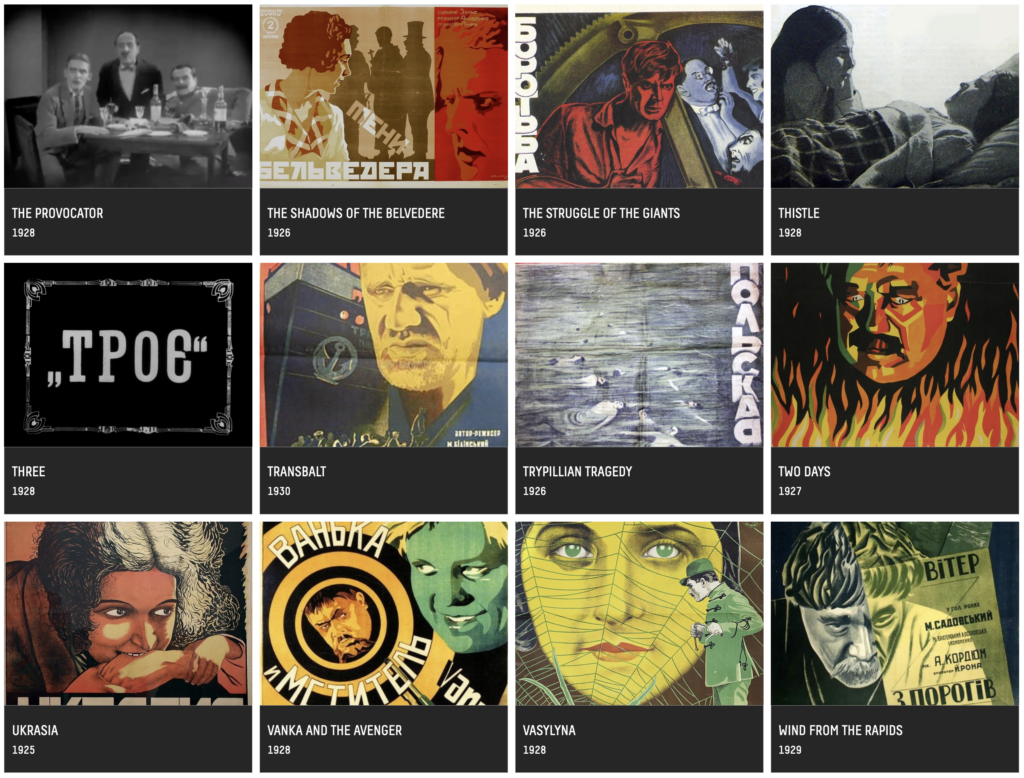
VUFKU (All-Ukrainian Photo Cinema Administration) existed for less than nine years (1922-1930), but it managed to release over 140 fiction films, several hundreds of non-fiction films and newsreels, dozens of animations, gain the fame of  “Ukrainian Hollywood”, and take under its control all aspects of the cinematic process – filmmaking, distribution, film press, propaganda, and education.

From over 140 full-length fiction films made by VUFKU, about 60 films are considered lost. A lot of the surviving films have come down to us incomplete (without one or more parts).

Economic success, cultural autonomy, and inclusive HR policies allowed VUFKU to involve the brightest artists, directors, cameramen, scriptwriters, critics of its time and become an international platform for many interdisciplinary experiments.

There were Dziga Vertov, Mikhail Kaufman, Oleskandr Dovzhenko, Ivan Kavaleridze, Vasyl Krychevskyi, Danylo Demutskyi, Petro Chardynin, Les Kurbas, Mykhail Semenko, Yurko Tiutiunnyk, and Yurii Yanovskyi among them.

After 1929, curbs, charges of bourgeois nationalism, formalism, and other unacceptable «perversions» led to the subordination of independent VUFKU to the all-union enterprise Soyuzkino and its transformation into a regional branch. In the following years, many of VUFKU representatives were repressed, physically exterminated, and those, who managed to immigrate, integrated themselves into film industries of other countries and became a part of their history.

Since then, the attributives «Soviet» and «Russian» became synonyms for a long time, and the vast majority of Ukrainian film heritage was taken to Moscow, and the best works of Ukrainian cinema of that time were included in the world circulation as «Russian avant-garde».

The search of the lost film treasures of the 1920s and their inclusion in the scientific circulation is important both as such and as a method of finding the European and urban identity of Ukrainian culture and restoring historical memory.
Source: https://vufku.org/en/information

work in progress


Type

Listing

Geographical area

Ukraine

Period

1920s20th centurySoviet Union

Language

English

Keywords

administrationanimationsavant-gardecinemafilmsnewsreelsnon-fiction-filmssoyuzkinoukrainian-culturevufku

Published : June 16, 2023

Share this source

Send by email

Share this source by email or save it by sending the data to your mail box.

Newsletter

Receive the latest sources each month

By clicking on the Subscribe button, you confirm that you have read our Data Protection policy.
Logo cnrsLogo ehessLogo cercec

The Online Primary Sources database is curated by
the french Centre for Russian, Caucasian and Central European Studies (CERCEC), a CNRS-EHESS joint research unit.

  • Credits
  • Legal Notice
  • Data Protection