Logo

Online Primary Sources

  • Home
  • All Sources
  • About
  • Newsletter
Filter by
PeriodGeographical areaInstitutionTypeLanguage
  • 10th century (1)
  • 11th century (1)
  • 12th century (1)
  • 13th century (2)
  • 14th century (2)
  • 15th century (2)
  • 16th century (2)
  • 17th century (2)
  • 18th century (2)
  • 19th century (3)
  • 20th century (5)
  • 21st century (1)
  • 4th Century (1)
  • 5th century (1)
  • 7th Century (1)
  • 8th Century (1)
  • 9th century (1)
  • Byzantine Empire (1)
  • Imperial Russia (3)
  • Ottoman Empire (2)
  • Post-Soviet Russia (1)
  • Russian Empire (2)
  • Safavid Dynasty (1)
  • Soviet Union (3)
  • Armenia (6)
  • Caucasus (1)
  • Egypt (1)
  • France (1)
  • Georgia (1)
  • Imperial Russia (1)
  • Iraq (1)
  • Ottoman Empire (1)
  • Russia (1)
  • Russian Empire (1)
  • Saudi Arabia (1)
  • Soviet Union (2)
  • Syria (1)
  • AGMI Foundation (1)
  • ARAM Organization (1)
  • Harold B. Lee Library, Brigham Young University (1)
  • HayBook (1)
  • Office Français de Protection des Réfugiés et Apatrides (OFPRA) (1)
  • Oxford University Press (1)
  • Russian National Library (1)
  • Audio (1)
  • E-book (2)
  • Image (4)
  • Pdf (3)
  • Transcript (1)
  • Arabic (1)
  • Armenian (7)
  • Belarusian (1)
  • English (4)
  • Estonian (1)
  • French (7)
  • Georgian (2)
  • German (1)
  • Komi (1)
  • Latvian (1)
  • Lithuanian (1)
  • Palestinian Arabic (1)
  • Persian (1)
  • Polish (1)
  • Russian (6)
  • Spanish (1)
  • Tatar (1)
  • Ukrainian (1)
  • Yiddish (1)

7 sources found in the database

for ArmenianFrench
  • Russian-Arab Worlds Archival Documents


    Oxford University Press

  • Armenian Ebooks


    HayBook

  • Sound Library with Armenian Music and Songs


    ARAM Organization

  • Photo Collection of the Armenian Genocide


    AGMI Foundation

  • History of Armenia: Primary Documents


    Harold B. Lee Library, Brigham Young University

  • Digitized Newspapers from the National Library of Russia


    Russian National Library

  • French Archives on Refugees or Stateless Persons


    Office Français de Protection des Réfugiés et Apatrides (OFPRA)

  • «
  • ‹
  • 1
  • ›

Russian-Arab Worlds Archival Documents


Institution

Oxford University Press

Url

https://global.oup.com/us/companion.websites/9780197605769/res/

The roots of the Arab world’s current Russian entanglements reach deep into the tsarist and Soviet periods. To explore those entanglements, the book Russian-Arab Worlds: A Documentary History presents and contextualizes a set of primary sources translated from Russian, Arabic, Armenian, Persian, French, and/or Tatar: a 1772 Russian naval officer’s diary, an Arabic slave sale deed from the Caucasus, an interview with a Russian-educated contemporary Syrian novelist, and many more (all documents availabla on-line). These archival, autobiographical, and literary sources, introduced by specialists and in some cases by pairs of scholars with complementary language expertise, highlight connections long obscured by disciplinary cleavages between Slavic and Middle East studies. Taken together, the 34 chapters of this book show how various Russian/Soviet and Arab governments sought to nurture political and cultural ties and expand their influence, often with unplanned results. They reveal the transnational networks of trade, pilgrimage, study, ethnic identity, and political affinity that state policies sometimes fostered and sometimes disrupted. Above all they give voice to some of the resourceful characters who have embodied and exploited Arab-Russian contacts: missionaries and diplomats, soldiers and refugees, students and party activists, scholars and spies. A set of new maps helps orient readers amid the expansion and collapse of empires, border changes, population transfers, and creation of new nation-states that occurred during the two centuries these sources cover.

Original Documents
Chapter 1, Witness to a New Era: Sergei Pleshcheev’s Diary of a Journey to Syria (1773)
Chapter 3, Shi‘i Worlds Interrupted: Waqf and Pilgrimage in Russia’s South Caucasus (1863-76)
Chapter 4, An Egyptian Teacher Heads to St. Petersburg:
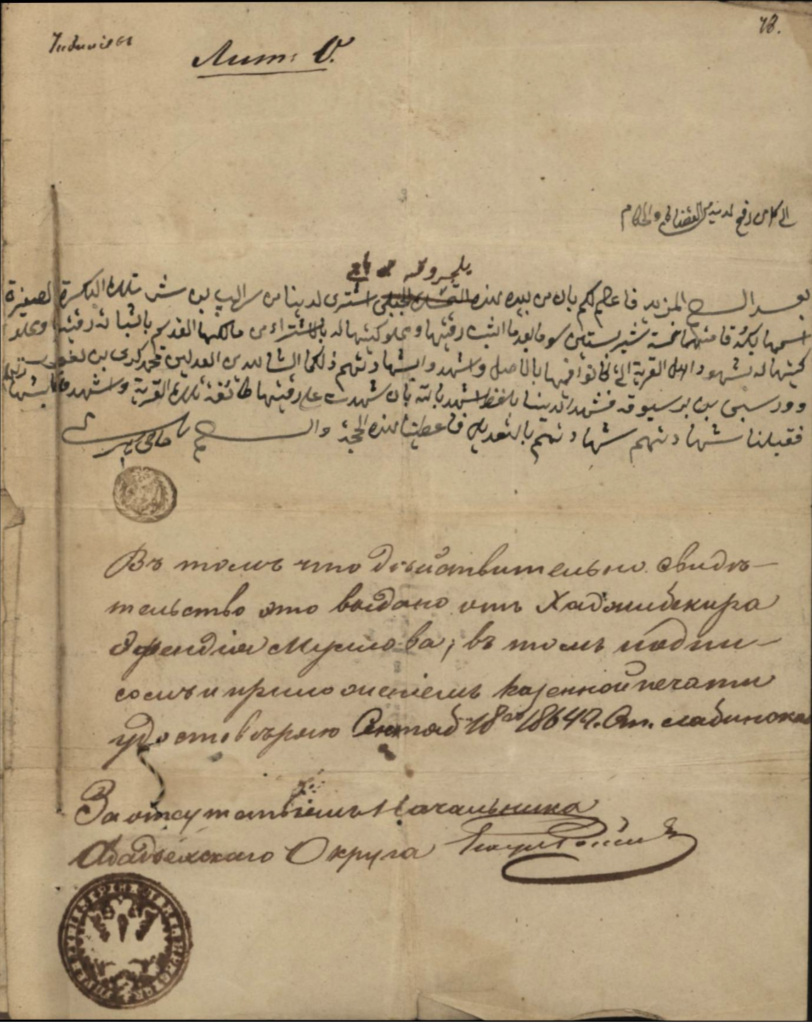
Chapter 5, A Slave Sale Deed from Russia’s North Caucasus (1864)
Chapter 6, Population Transfer: Negotiating the Resettlement of Chechen Refugees in Ottoman Lands (1865,1870)
Chapter 7, Russianizing Palestine: Vasilii Khitrovo’s A Week in Palestine
Chapter 9, Orthodoxy Across Borders: Maps of the Institutions of the Imperial Orthodox Palestine Society (IPPO)
Chapter 10, A Reluctant Native Intermediary: Shakhirdzhan Ishaev’s Journey to Mecca (1896)
Chapter 12, Saluting Russia’s Islamic Modernists in the Cairo and Beirut Arabic Press (1899)
Chapter 13, Russian and Soviet Oil Exports to the Persian Gulf (1903-33)
Chapter 14, Memo to Stalin: Lev Karakhan’s Argument for Establishing Soviet Diplomatic Ties with the Hejaz (1923)
Chapter 15, Soviet Muslims at the Congress of the Muslim World in Mecca (1926)
Chapter 16-Arabic in the Soviet Caucasus:
Chapter 17, From Syrian Communist to Soviet Orientalist: Taha Sawwaf in the Comintern Files (1935-53)
Chapter 19, Armenian Immigration to the USSR from Arab Countries (1946-49)
Chapter 20, The Abandoned Comrades: Egyptian Communists’ Pleas to the USSR (1953-54)
Chapter 22, From Nazareth to Moscow: Kulthum ‘Awda Vasilieva’s “Happy Life” in Russia (1927, 1937, 1965)
Chapter 24, Should Dormitory Bathrooms Have Doors? Zakaria Turki ’s A Sa‘idi Among the Russians
Chapter 30, Ba‘thists in Baku: Iraq-Syria Tensions Come to the USSR (1975-77)
Chapter 32, Aeroflot Routes to Baghdad: Soviet-Iraqi Relations during the Iran-Iraq War (1980-81)
Chapter 34, “The Intellectual is a Hybrid Creature”: Khalil Alrez’s The Russian Quarter (2019)
 

[Illustration: A Slave Sale Deed from Russia's North Caucasus (1864)] 


Type

Pdf

Geographical area

ArmeniaCaucasusEgyptImperial RussiaIraqOttoman EmpireSaudi ArabiaSoviet UnionSyria

Period

Imperial RussiaSoviet Union

Language

ArabicArmenianFrenchPalestinian ArabicPersianRussianTatar

Keywords

archival-documentscommintern-filesdiaryinterviewmapsorthodox-churchsoviet-muslims

Published : February 22, 2023

Share this source

Send by email

Share this source by email or save it by sending the data to your mail box.

Newsletter

Receive the latest sources each month

By clicking on the Subscribe button, you confirm that you have read our Data Protection policy.
Logo cnrsLogo ehessLogo cercec

The Online Primary Sources database is curated by
the french Centre for Russian, Caucasian and Central European Studies (CERCEC), a CNRS-EHESS joint research unit.

  • Credits
  • Legal Notice
  • Data Protection