
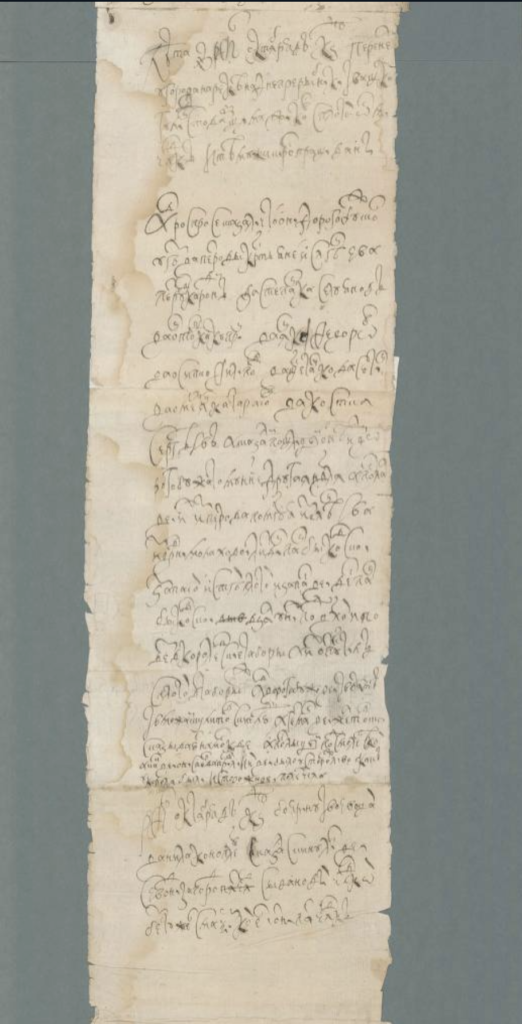
The Smolensk Archives, 1604-1611
The Smolensk Archives mainly contain administrative documents from the governor's office in Smolensk during the siege of the city by the Polish King Sigismund III (1609-1611). Most of the documents are kept at the National Archives (about 1,300 sheets), but a few hundred sheets kept at the Archives of the Institute of History of the Russian Academy of Sciences in St Petersburg can also be attributed to the same origin.
The documents of the Smolensk Archive were taken by the Swedes as war booty in Poland in the mid-17th century. They were kept at Skokloster Castle until 1893, when they were transferred to the National Archives together with the Skokloster Collection. The Russian historian Sergei Vasil'evič Solev'ev visited Skokloster in the 1830s, and he brought back several documents from the collection. Many of these were published in Akty istoričeskie as early as 1841. Many of the documents that remained in Sweden were published in 1912 by Yuri Got'e in "Pamjatniki oborony Smolenska 1609-1611". However, several documents remained unpublished.
The database "Smolensk Archives 1604-1611" contains 847 records and recreates in digital form the original Smolensk collection from Skoklosters Castle. It is possible to search by year, date, content (in English and in Russian), personal names. Scanned copies of the originals are available only for the documents stored at the National Archives. For the documents in St Petersburg, transcripts of the original texts are available in the database records.
The menu on the left contains indexes (personal names, place names, monasteries, churches), glossary and principles of the information in the various fields of the catalogue.
Catalogue: https://riksarkivet.se/Media/pdf-filer/NAD/Introduction.pdf
[Illustration: Sheet 1: Fragment of a matter concerning the nun Aleksandra (6 lines) Sheet 2-3: Matter concerning the escape from Smolensk of Vasilij Čichačev’s son and servant (interrogation). 11 October 1611. No end. 7 lines in PEA 2 [part A] are not found in Got’e 1912, no. 170.]
Published : December 20, 2022