Logo

Online Primary Sources

  • Home
  • All Sources
  • About
  • Newsletter
Filter by
PeriodGeographical areaInstitutionTypeLanguage
  • 18th century (1)
  • 19th century (8)
  • 20th century (11)
  • 21st century (1)
  • Imperial Russia (1)
  • Pre-Soviet Russia (1)
  • Revolution (1)
  • Russian Empire (1)
  • Soviet Union (3)
  • World War II (1)
  • Austro-Hungarian Empire (1)
  • Azerbaijan (1)
  • Baku (1)
  • Belarus (2)
  • Belorussia (1)
  • Bielorussia (1)
  • Bukovina (1)
  • Central Europe (3)
  • Czernowitz (1)
  • Daghestan (1)
  • Eastern Europe (4)
  • Georgia (1)
  • Hungary (1)
  • Imperial Russia (2)
  • Israel (2)
  • Lithuania (3)
  • Moldova (2)
  • Moscow (1)
  • North Caucasus (1)
  • Poland (3)
  • Romania (2)
  • Russia (6)
  • Russian Empire (3)
  • Soviet Union (4)
  • Transcaucasia (1)
  • Ukraine (1)
  • USA (1)
  • Vilna (1)
  • Vilnius (1)
  • Vladikavkaz (1)
  • Blavatnik Foundation (2)
  • Central Jewish Library, Poland (1)
  • DiFMOE Digitales Forum Mittel- und Osteuropa (1)
  • National Library of Israel (2)
  • SEFER Center (1)
  • The Edward Blank YIVO Vilna Online Collections (2)
  • The New York Public Library Digital Collections (1)
  • YIVO Institute for Jewish Research (1)
  • Audio (1)
  • E-book (1)
  • Image (11)
  • Pdf (3)
  • Video (1)
  • Austrian (1)
  • Belarusian (1)
  • English (3)
  • French (2)
  • German (4)
  • Hebrew (11)
  • Hungarian (2)
  • Lithuanian (1)
  • Polish (6)
  • Romanian (3)
  • Russian (8)
  • Serbian (1)
  • Ukrainian (2)
  • Yiddish (11)

11 sources found in the database

for HebrewYiddish
  • Database of Jewish History, Culture, and Material Heritage in Eastern European Countries, Non-European Regions of Russia and the Post-Soviet Space


    SEFER Center

  • The May Cohn Russia and Soviet Union Collection (Vilna Archives) on Jewish life in the Russian Empire and the Soviet Union


    The Edward Blank YIVO Vilna Online Collections

  • Vilna Chief of Police Records, 1831-1918


    The Edward Blank YIVO Vilna Online Collections

  • Jewish German Bukovina Collection


    DiFMOE Digitales Forum Mittel- und Osteuropa

  • Central & Eastern Europe Judaic Newspaper Collection (19th-20th Century)


    Central Jewish Library, Poland

  • Judaica Poster Collection 1910s-1940s


    Blavatnik Foundation

  • Historical Central & Eastern Europe Jewish Press (1860-1939)


    National Library of Israel

  • Yizkor (Memorial) Book Collection in Hebrew & Yiddish


    The New York Public Library Digital Collections

  • The YIVO Encyclopedia of Jews in Eastern Europe


    YIVO Institute for Jewish Research

  • Moscow State Yiddish Theater Collection


    Blavatnik Foundation

  • Historical Jewish Press Collection


    National Library of Israel

  • «
  • ‹
  • 1
  • ›

Jewish German Bukovina Collection


Institution

DiFMOE Digitales Forum Mittel- und Osteuropa

Url

https://www.difmoe.eu/d/search/?collections=vc:6de9af0f-6c93-4f4c-ac6d-a57f3f352715

The Digital Forum Central and Eastern Europe e.V. (DiFMOE, Munich) would like to refer to its current cooperation project, which is being carried out in cooperation with the Institute for German Culture and History in Southeastern Europe (IKGS), the Institute for Foreign Cultural Relations (IFA, Stuttgart), the University and State Library Düsseldorf, the Bukovina Institute (Augsburg), the National Library of Israel (Jerusalem), the World Organization of Bukovina Jews (Ramat Gan, Israel), the Martin-Opitz-Library (Herne), the Leibniz Institute for East and Southeast European Studies (IOS, Regensburg) and the Czernowitz Discussion Group.

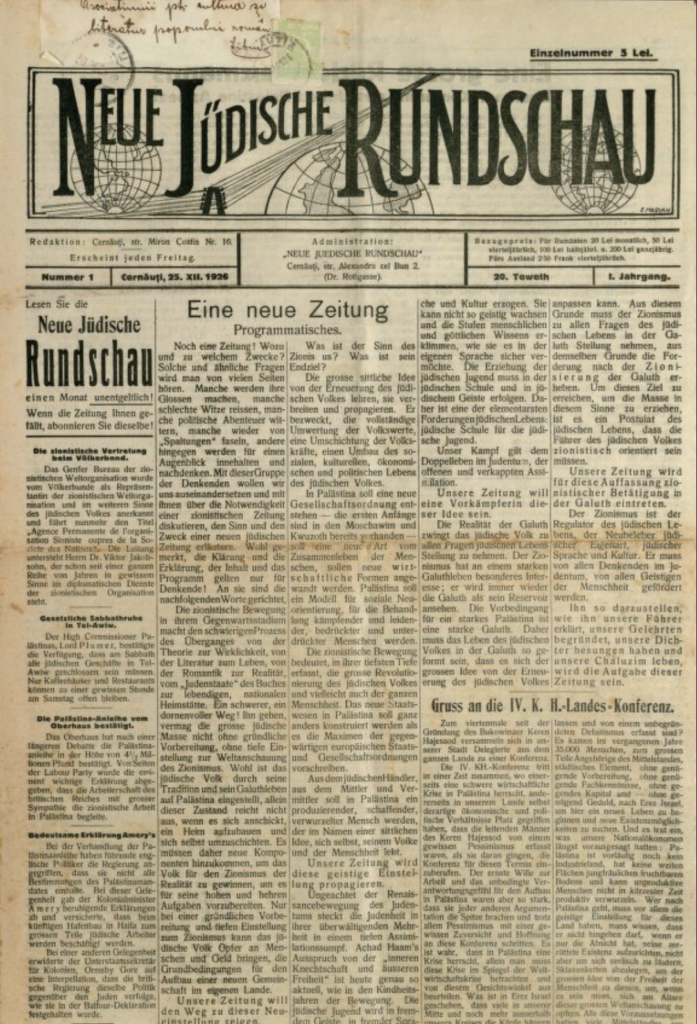
The new collection consists of several parts. On the one hand, there are 16 historical newspapers that were produced in the former Austrian and then Romanian Bukovina in the interwar period, mainly under Jewish editorship in German and Yiddish. Liberal papers such as the “Czernowitzer Morgenblatt” or the “Czernowitzer Allgemeine Zeitung” found their readership in broad circles of the German-speaking population groups, as they represented the interests of all national minorities in the new state. The “Tšernowitzer bleter”, the “Arbeter Tsaytung” or “Di frayhayt”, printed in Yiddish, on the other hand, reflect political, cultural and ideological internal Jewish discourses against the background of the ongoing curtailment of the basic rights of Jews by the Romanian government. With the “Czernowitzer Deutsche Tagespost”, a newspaper was also taken into account, which after 1933, in unison with and supported by Berlin, participated in the numerous anti-Semitic smear campaigns that ultimately resulted in the extermination of a large part of the Jewish population in Bukovina. “Die Stimme”, launched in 1944 by Elias Weinstein in what was then the British Mandate of Palestine and still published in Israel today, became a printed information and communication platform for survivors after the Holocaust.

In addition to digitizing this periodical source corpus and putting it online, DiFMOE, in cooperation with the Czernowitz Discussion Group, the global virtual association of around 500 Jewish Bucovinian Holocaust survivors and their descendants, integrated selected parts of the group's own archive with valuable personal and family documents in the digital library. Within the Jüdisch-Deutsche Bukowina 1918+ collection, the around 1,000 objects can be viewed both in their entirety and sorted by the individual private collections of the members.

The German administrator of the Czernowitz Discussion Group, Edgar Hauster, made a special source available from his personal family archive: 122 letters from the correspondence of grandfather Elias Hauster with his son Julius Hauster (the second son Maximilian was murdered in Auschwitz in 1943) give the reader a profound impression of everyday life, of mental life, but above all of the great plight of the Romanian Holocaust survivors immediately after the end of the Second World War (1946-1949). For the best possible (scientific) use of the contents of the outstanding historical record "The Correspondence of Elias Hauster", the high-resolution scans of the handwritten letters were combined with the transcriptions, which were also elaborately created by Edgar Hauster, in a digitally created book and thus made full-text searchable.


Type

ImagePdf

Geographical area

Austro-Hungarian EmpireBukovinaCzernowitzMoldovaRomaniaUkraine

Period

19th century20th century

Language

AustrianGermanHebrewHungarianRomanianRussianYiddish

Keywords

booksfamily-archivesjewslettersmapsnewspapersperiodicalsphoto-collectionpostcardspostersprogramstheatre

Published : April 15, 2021

Share this source

Send by email

Share this source by email or save it by sending the data to your mail box.

Newsletter

Receive the latest sources each month

By clicking on the Subscribe button, you confirm that you have read our Data Protection policy.
Logo cnrsLogo ehessLogo cercec

The Online Primary Sources database is curated by
the french Centre for Russian, Caucasian and Central European Studies (CERCEC), a CNRS-EHESS joint research unit.

  • Credits
  • Legal Notice
  • Data Protection