Logo

Online Primary Sources

  • Home
  • All Sources
  • About
  • Newsletter
Filter by
PeriodGeographical areaInstitutionTypeLanguage
  • 18th century (1)
  • 1917 (1)
  • 1920s (1)
  • 1990-1992 (1)
  • 19th century (2)
  • 20th century (12)
  • 21st century (2)
  • Holocaust (1)
  • Imperial Russia (1)
  • Interwar Period (1)
  • Post-Soviet Russia (2)
  • Russian Empire (1)
  • Soviet Union (7)
  • World War 1 (1)
  • World War II (4)
  • Armenia (1)
  • Azerbaijan (2)
  • Belarus (2)
  • Caucasus (1)
  • Central Asia (1)
  • Central Europe (2)
  • Crimea (1)
  • Eastern Europe (3)
  • Estonia (2)
  • Former Soviet Union (2)
  • France (2)
  • Georgia (1)
  • Germany (1)
  • Imperial Russia (1)
  • Kazakhstan (2)
  • Kirghizistan (1)
  • Kyrgyzstan (2)
  • Latvia (2)
  • Lithuania (2)
  • Moldova (1)
  • Nagorno-Karabakh (1)
  • Pale of Jewish Settlement (1)
  • Post-Soviet Russia (1)
  • Post-Soviet Spaces (2)
  • Russia (5)
  • Russian Empire (1)
  • Soviet Republics (14)
  • Soviet Russia (1)
  • Soviet Union (13)
  • Tajikistan (1)
  • Turkmenistan (1)
  • Ukraine (1)
  • United Kingdom (1)
  • USA (1)
  • Alena Ledeneva (Ed.) (1)
  • ALEXANDER N. YAKOVLEV ARCHIVE (1)
  • Astrakhan State University (1)
  • Blinken OSA Archivum at Central European University (1)
  • Eisenstein Center Regional Public Foundation (1)
  • Institute for Research on Cinematic Art (1)
  • John Madison College (1)
  • Kibbutz of the Ghetto Fighters’ (1)
  • Moscow State University (1)
  • Perry-Castañeda Library, University of Texas Libraries (1)
  • Private Initiative (3)
  • Russian Ministry of Defence (1)
  • Russian Museum, Museums of Russia and CIS countries (1)
  • University of Florence (1)
  • Viacheslav Rumiantsev (1)
  • Audio (1)
  • Image (6)
  • Interactive map (1)
  • Links (2)
  • Listing (3)
  • Pdf (2)
  • Transcript (5)
  • Video (3)
  • English (7)
  • Hebrew (1)
  • Italian (1)
  • Russian (9)

14 sources found in the database

for Soviet Republics
  • "Kinovedcheskie Zapiski" istoriko-teoriticheskii zhurnal (1988-today)


    Eisenstein Center Regional Public Foundation

    Institute for Research on Cinematic Art

  • "eSamizdat. Rivista di culture dei paesi slavi” Scientific Journal (2003-today)


    University of Florence

  • Ghetto Fighters House Archives


    Kibbutz of the Ghetto Fighters’

  • RETROMAP - Old Maps of Russian and Foreign Cities


    Private Initiative

  • "Zhurnal frontirnykh issledovanii" (2016-today)


    Astrakhan State University

  • From Numbers to Names Database - Identification of Holocaust Photo and Video Archives


    Private Initiative

  • Video Recordings of Soviet and Russian Television Programs, 1985-1994


    Blinken OSA Archivum at Central European University

  • Secret Document "On the State and Activities of Religious Cults in the USSR in 1951"


    ALEXANDER N. YAKOVLEV ARCHIVE

  • "100th Anniversary of the Formation of the Union of Soviet Socialist Republics" Inter-Museum Virtual Exhibition


    Russian Museum, Museums of Russia and CIS countries

  • Global Informality Online Project


    Alena Ledeneva (Ed.)

  • Documents of the XX Century


    Private Initiative

    Viacheslav Rumiantsev

  • Collapse & Rebirth: “Living Archive” on the Collapse of the USSR


    John Madison College

    Moscow State University

  • «
  • ‹
  • 1
  • 2
  • ›

Ghetto Fighters House Archives


Institution

Kibbutz of the Ghetto Fighters’

Url

https://www.gfh.org.il/eng/Archive

The Ghetto Fighters' House Archives were established along with the founding of Kibbutz Lohamei Haghetaot (Kibbutz of the Ghetto Fighters’). Despite the difficulties, the kibbutz members began collecting official and personal documents and photographs to document the Holocaust period and the communities that were destroyed. The work of collecting and sorting was viewed by the kibbutz members as carrying out the Last Will and Testament of those who perished, and a direct continuation of documentation work done in the ghettos.

The GFH Archives hold various kinds of materials, among them: letters, personal official documents, diaries, testimonies (written, audiotaped, and videotaped), films, photographs, an art collection, and an artifacts collection. The Archives deal with the documentation of three main periods in the history of the Jewish People: between the two World Wars – youth movements, religious life, community life and culture; the fate of the Jewish people during WWII – in camps and ghettos, physical and spiritual Jewish resistance; and the Holocaust survivor community in postwar Europe.

The GFH Archives maintain a data base accessible to the public. At present, the Archives are in the midst of a digitization project, working to make the holdings available via the Internet, catalogues and academic conferences. Many of the items are already available in the online archives accessed through the GFH website. Among the holdings are unique collections, including of the poet and playwright Itzhak Katzenelson; renowned educator Janusz Korczak; the Lodz ghetto; the “Zionist Coordination” for the discovery and recovery of Jewish children in postwar Poland who had been placed with non-Jews in wartime; Adolf-Avraham Berman’s collection on underground activity in Warsaw after the ghetto’s liquidation; stage director Jonas Turkow’s collection on theatre and culture in the Warsaw ghetto; the Zionist pioneering organization HeHalutz; the collection of children’s testimonies compiled by Benjamin Tene, an emissary of the HaShomer HaTzair movement in postwar DP camps; Yisrael Kaplan’s collected testimonies of Holocaust survivors from Lithuania; a collection of personal materials on Dutch Jewry; photos from the British internment camps in Cyprus for clandestine Jewish immigrants to Mandate Palestine; the Art Collection; the Artifacts Collection, and more.

Thanks to the generous donation made by the Association of Jews from Mlawa in Israel, the Archives have set up a researchers’ room, in memory of the Jewish community of Mlawa, Poland. The renovation and refurbishment of the room were made possible with the aid of the Claims Conference (Conference on Jewish Material Claims against Germany). The room’s computers are outfitted with a search program enabling direct access to all the archives collections that have been digitized and catalogued.

The Archives are a resource for the GFH Museum’s educational programs and its exhibitions. The “Yizkor” Hall exhibits artifacts from the GFH collection and artworks from the Art Collection. This exhibition is about memory and coping with it, commemorating the Jewish communities that were destroyed and the people who built and lived in them, enabling exposure to these two important collections of the Archives’ holdings.


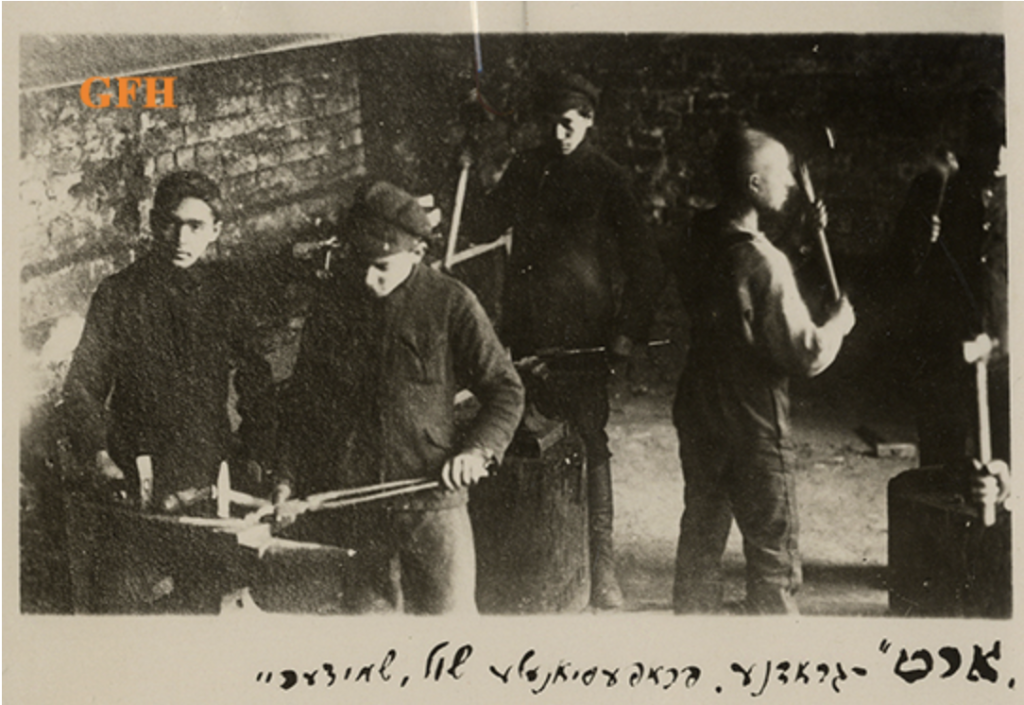
[Illustration: Young Jews studying blacksmithing at a trade school of the ORT vocational training organization in Grodno. Photographed in the latter half of the 1920s, evidently in 1927; Catalog No.: 61185


Type

Listing

Geographical area

Eastern EuropeSoviet RepublicsSoviet Union

Period

20th centuryInterwar PeriodSoviet UnionWorld War II

Language

EnglishHebrew

Keywords

archivesart-collectionscampscommunity-life-and-culturediariesfate-of-the-jewish-peoplefilmsghettosholocaust-survivor-communityjewish-resistancejewslettersortpartisanspersonal-documentspersonal-official-documentsphotographsreligious-lifetestimoniesunderground-activityyouth-movements

Published : November 18, 2024

Share this source

Send by email

Share this source by email or save it by sending the data to your mail box.

Newsletter

Receive the latest sources each month

By clicking on the Subscribe button, you confirm that you have read our Data Protection policy.
Logo cnrsLogo ehessLogo cercec

The Online Primary Sources database is curated by
the french Centre for Russian, Caucasian and Central European Studies (CERCEC), a CNRS-EHESS joint research unit.

  • Credits
  • Legal Notice
  • Data Protection