
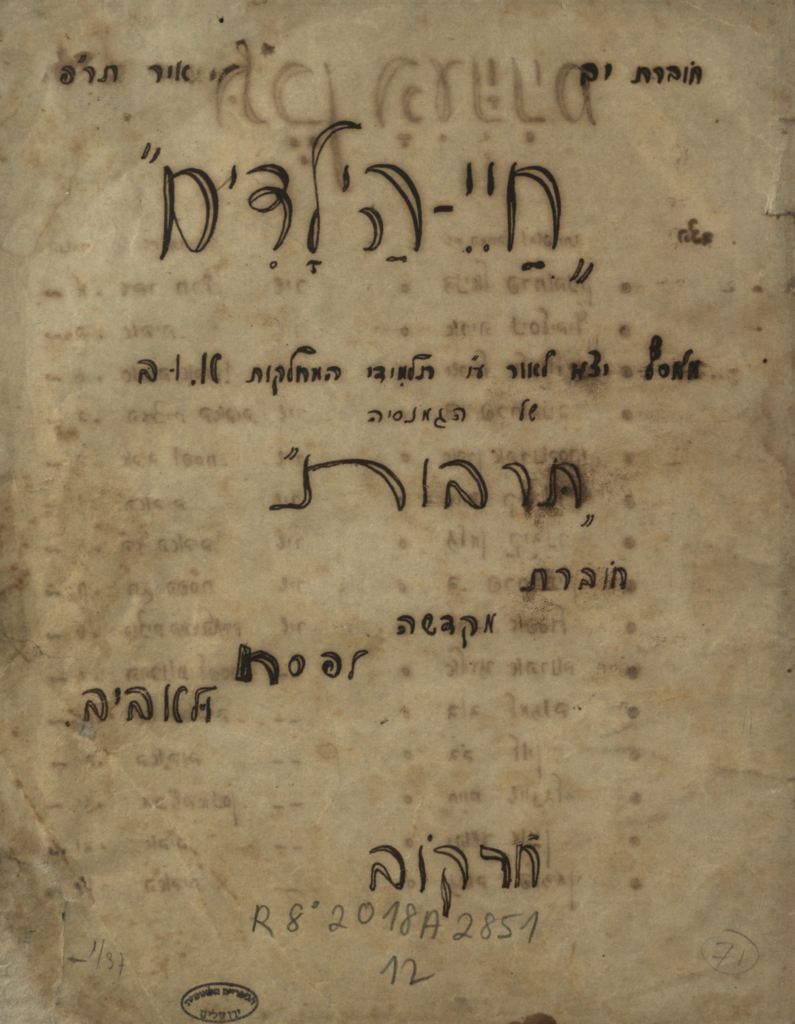
Children's Lives: Collected & Published by Students in grades A and B of the Tarbut Gymnasium, Kharkiv, 1920
The National Library of Israel’s Rare Items Collection contains a special booklet of poems and stories written by boys and girls in the city of Kharkiv, Ukraine, ahead of the Passover holiday in the year 1920.
A language in the process of revival needs speakers, young speakers most of all: nursery, kindergarten and school age children, who will grow up speaking the language fluently and freely. Apart from speakers, such a language also needs tools for teaching it, and the main early tool developed by the Zionist movement to teach its young followers Hebrew was a compilation of stories, songs, poems, and rhymes. In 1887, Eliezer Ben-Yehuda and David Yellin published the first Hebrew “Reader for Jewish Children” (המקראה לילדי ישראל).
In the last few decades of the nineteenth century and until after World War II, teachers, students, and writers contributed hundreds of original Hebrew texts for the benefit of the young learners in the many Hebrew schools established in Europe. It was a huge project in both its scope and importance, and yet, anyone who has ever studied a foreign language knows that even that it is not enough.
The first stage in language learning is passive absorption; the second stage is practice. The booklet “The Lives of Children” is a vivid example of this second stage: the transition from reading to writing, from passive absorption to spontaneous creation. The truth is that students of the “Tarbut” school (tarbut is Hebrew for “Culture”) in the city of Kharkiv in Ukraine could not have chosen a more appropriate theme for their reader: the renewal of spring and the commemoration of the liberation of the Israelites from slavery to freedom on Passover.
The Tarbut organization, which aimed to establish a network of Hebrew schools across Eastern Europe, was founded only three years before the publication of the booklet, in April 1917, in Moscow. It was a fateful year that saw the fall of the tsar and which ended with the establishment of the Bolshevik government, hostile to both Zionism and the Hebrew language. Following the Russian Civil War and especially due to the Bolsheviks’ anti-Zionist policy, the Tarbut organization was forced to close its Moscow headquarters and start again from scratch in Kiev, Odessa, and Krakow in mid-1918. At first, Tarbut’s Ukrainian branch received short-term funding from the independent Ukrainian government, but this ended when the communists took over that country as well. It also spelled the end for the short-lived flourishing of Hebrew in Ukraine. The booklet from the Tarbut school in Kharkiv was published during that small window.
The booklet “The Lives of Children” offers us a glimpse into the world of Kharkiv’s Jewish children in their own words, in clear and elegant Hebrew. Each piece of prose or poetry is accompanied by the writer’s name, and all the writings, as mentioned, deal with the coming of spring and the festival of Passover. It is in fact a collection of “songs, stories, memories, impressions, and imaginings,” by first and second division Tarbut students. From the texts, it is clear that these are not first or second graders, but most likely boys and girls around the age of 14 or 15.
Following the table of contents is an illustration of a peaceful landscape with the caption, “On the shores of the Dnieper”— that is the Dnieper River, which flows from Russia through Belarus and Ukraine to the Black Sea.
Published : March 27, 2022