
Documents of the Great Patriotic War
Internet project "At the headquarters of the Victory. 1941-1945" is based on the series of exhibitions "At the Victory HQs: "At the Victory HQs 1941-1945 (Moscow, Novy Manezh, April 22 - May 15, 2015), "1941. At the Victory Headquarters" (Moscow, Novy Manezh, May-June 2016), "1942. At the Victory Headquarters" (Moscow, Novy Manezh, May-June 2017), "1943. At the Victory Headquarters" (Moscow, Novy Manezh, May-June 2018), "1944-1945. In the Headquarters of Victory" (Moscow, Novy Manezh, May-June 2019). The project presents the most important documents for the entire period of the Great Patriotic War.
The most important factor of Victory in the Great Patriotic War was the ability of the country's leadership to mobilize all forces and resources, ensure the unity of the front and the rear, organize the uninterrupted work of all sectors of the national economy in the difficult conditions of wartime. The presented project resolves the problem of describing the life and defense of the country through the prism of activities of the supreme governing bodies of the country during the war years, on the basis of the most important documentary sources.
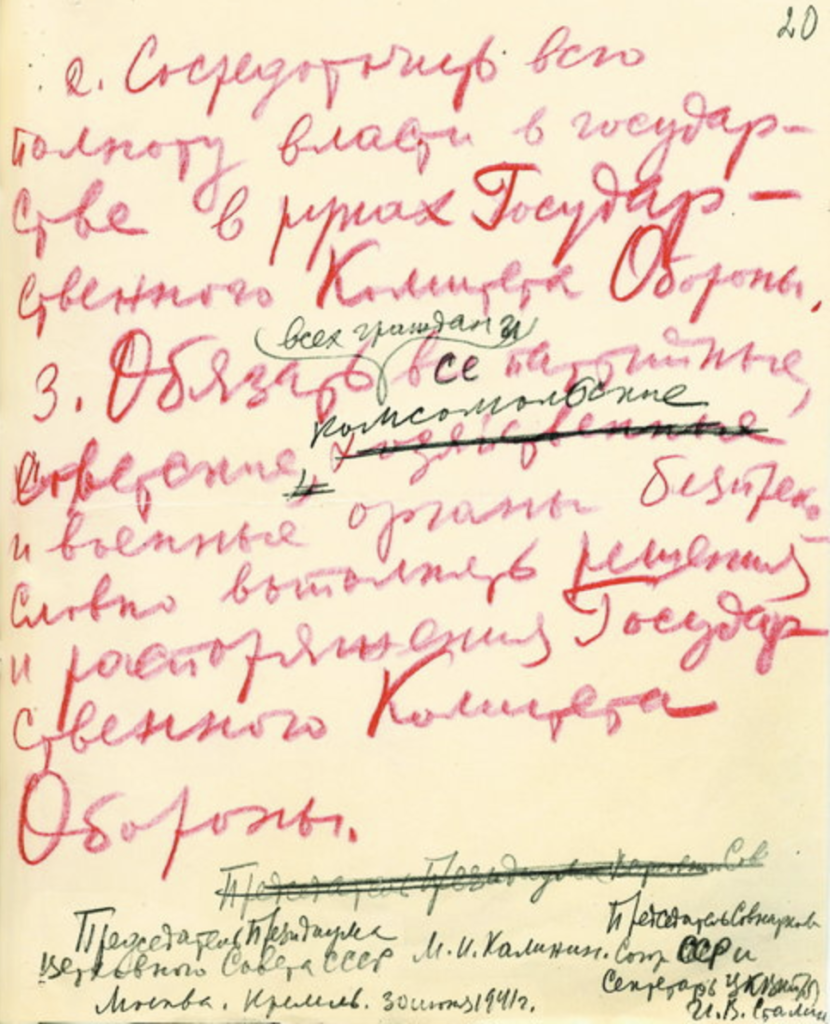
The project includes documents of the State Defense Committee of the USSR, the Supreme Command Headquarters, the General Staff of the Red Army, the Politburo, the Soviet of People's Commissars, the Supreme Soviet of the USSR, with autographs of Stalin, Molotov, A. S. Scherbakov, Zhdanov, Malenkov, Mikoyan, Kaganovich, Kalinin, Beria, Ponomarenko, Zhukov, Rokossovsky, Sokolovsky, Malinovsky, Sandalov, Konev, and other Soviet military and statesmen. The presented documents had a decisive influence on the outcome of military operations, international relations, political, economic and cultural life of our country.
The Internet project provides 714 documents systematized in four sections thematically and chronologically: governance and rearmament, the Red Army and liberation, the occupied territory and the anti-Hitler coalition.
The internet project opens with the historical introduction revealing the theme of state administration during the Great Patriotic War.
The first section "Public administration and rear" consists of 9 thematic blocks: public administration, mobilization, evacuation, industry, weapons of victory, medicine, church, culture and science.
The documents tell about the creation and activity of new organs of state administration, general mobilization to the Red Army and people's militia divisions, evacuation of population and defense industrial enterprises to the East, development and production of weapons, organization of medical care and the role of doctors during the war, patriotic service of religious organizations and state-church relations, work of theaters, movie studios, front correspondents, scientific institutions and scientific works, atomic project and jet
The second section "Military confrontation" consists of 7 thematic blocks: the Red Army, the battle for Moscow, Leningrad Blockaded, Stalingrad, liberation of the USSR, liberation of European countries and Victory.
The documents tell about the creation of military units, defense battles of the initial stage of the war, key military operations in the USSR and the liberation of European countries, the end of the war and the establishment of the date of surrender and Victory Day.
The third section "In the Occupied Territories" contains five thematic blocks: partisan movement, Komsomol, collaborationism, concentration camps and life under occupation.
The documents tell about the formation of partisan movement, the establishment of central and republican and regional headquarters of partisan movement, key partisan operations, activity of "Young Guard" and underground Komsomol organizations in the temporarily occupied territory of the USSR, the activities of Ukrainian, Baltic and Russian Komsomol organizations, partisan movement in the occupied Soviet Union, This section covers the activities of Ukrainian, Baltic and Russian collaborationist and nationalist formations, the treachery and capture of General Vlasov, the situation in the temporarily occupied territory of the Soviet Union and the policy of the Third Reich toward the civilian population, the situation of prisoners in German concentration camps and their liberation.
The fourth section, Anti-Hitler coalition, consists of 5 chronological blocks: 1941, 1942, 1943, 1944, 1945.
The documents tell about the formation of the anti-Hitler coalition, relations of "Big Three" leaders, supplies of lend-lease, opening of the second front and three Allied conferences: Teheran, Crimean, and Potsdam Conferences.
Keywords
Published : December 25, 2020