
Nukus Museum Collections
The Nukus Museum was established in 1966 on the initiative of artist and collector Igor Vitalievich Savitsky, whose efforts were supported by representatives of the Karakalpak ASSR’s governing bodies, including the Regional Committee of the Communist Party, the Council of Ministers, and the Academy of Sciences of the autonomous republic.
Three major periods can be distinguished in the history of the Museum.
The first was associated with the formation of the core of the museum collection, which was unprecedented in both quantity and quality for museums in the Soviet autonomous republics. This period did not end with the death of I.V. Savitsky in 1984, as many works previously selected by the museum’s founder from various collections continued to be added to the Nukus collection until the late 1980s.
The second period began after the collapse of the USSR, when the museum had to restructure its operations amid an economic crisis and ideological changes. Notable achievements of the museum from 1991 to 2015, during the tenure of Marinka Maratovna Babanazarova, included the resolution of outstanding issues regarding works acquired by I.V. Savitsky, the construction of new museum buildings, the successful entry into international exhibition venues, and the publication of several catalogs of works from the Nukus collection.
The third, contemporary period began in the summer of 2015, when M.M. Babanazarova was dismissed, and the museum became the subject of a prosecutor’s investigation into alleged substitutions and thefts of works, as well as a series of administrative changes in the museum’s leadership. During this period, the international media repeatedly expressed concerns about the future of I.V. Savitsky’s collection. It was precisely this concern for preserving the integrity of the museum’s collection that led to the establishment of the Alerte Héritage Observatory and the launch of the project for an open public catalog of the Museum.
Typologically, I.V. Savitsky’s collection is organized around four main themes: folk art and archaeological antiquities of Karakalpakstan; the art of Central Asia in general and Uzbekistan in particular from the 1920s to the 1960s; Soviet art from the 1920s to the 1960s, and new Karakalpak art from the 1950s to the 1980s. With regard to Uzbek and Karakalpak art, as well as individual artists from Central Asia (Ilya Mazel), the Nukus collection includes an extensive and highly significant body of work. The collection of Soviet art was primarily built around works by artists who were pushed into the background—or even further into the shadows—by the towering figures of Kazimir Malevich, Wassily Kandinsky, Pavel Filonov, and other giants of the avant-garde movements of the 1910s–1930s, none of whose works are present in Nukus. We are talking about artists who have been unjustly forgotten, underappreciated by their contemporaries, and who often disappeared without a trace during the years of Stalinist repression.
Regarding the number of items held in the Nukus collection, the sources available to us do not provide definitive figures. As M.M. Babanazarova noted in the catalog “Les Survivants des Sables Rouges,” in 1998 the Museum held more than 82,000 inventory items. The latest figures in various media sources put the number at 90,000 or more exhibits. A serious problem is that to date, no more than 1,000 works of painting and graphic art—constituting the main and most valuable part of I.V. Savitsky (after compiling all the Museum catalogs available to us, we obtained about 800 images, while the remaining photographic reproductions published in this virtual project were taken by us—civil activists and art lovers—within the Museum itself or at its traveling exhibitions). Thus, the overwhelming majority of the works in the collection remain unknown to anyone other than the Museum’s curators to this day.
The inconsistency in estimates of the number of works by specific artists is also troubling. For example, some sources indicate that the Museum holds “more than 700 works” by Nikolai Karakhan, while others cite “around 1,000.” The difference is enormous, yet to preserve the artist’s legacy, it would be necessary to know the exact number. In the catalogs of the Nukus Museum and other printed publications, we were able to find only 31 images from this undefined collection, meaning that only these 31 works currently enjoy some protection against theft and forgery. Let us hope that, over time, museum visitors will be able to photograph other exhibits in the periodically changing exhibition and that the museum administration will respond to persistent calls to create and publish a comprehensive digital catalog of the collection, accessible to all.
While we await this moment, we invite our readers—both experts and enthusiasts—to use the public open catalog [http://nukus.open-museum.net/author/] Alerte Héritage, which is currently the most comprehensive collection of reproductions of works from the Nukus Museum ever published anywhere.
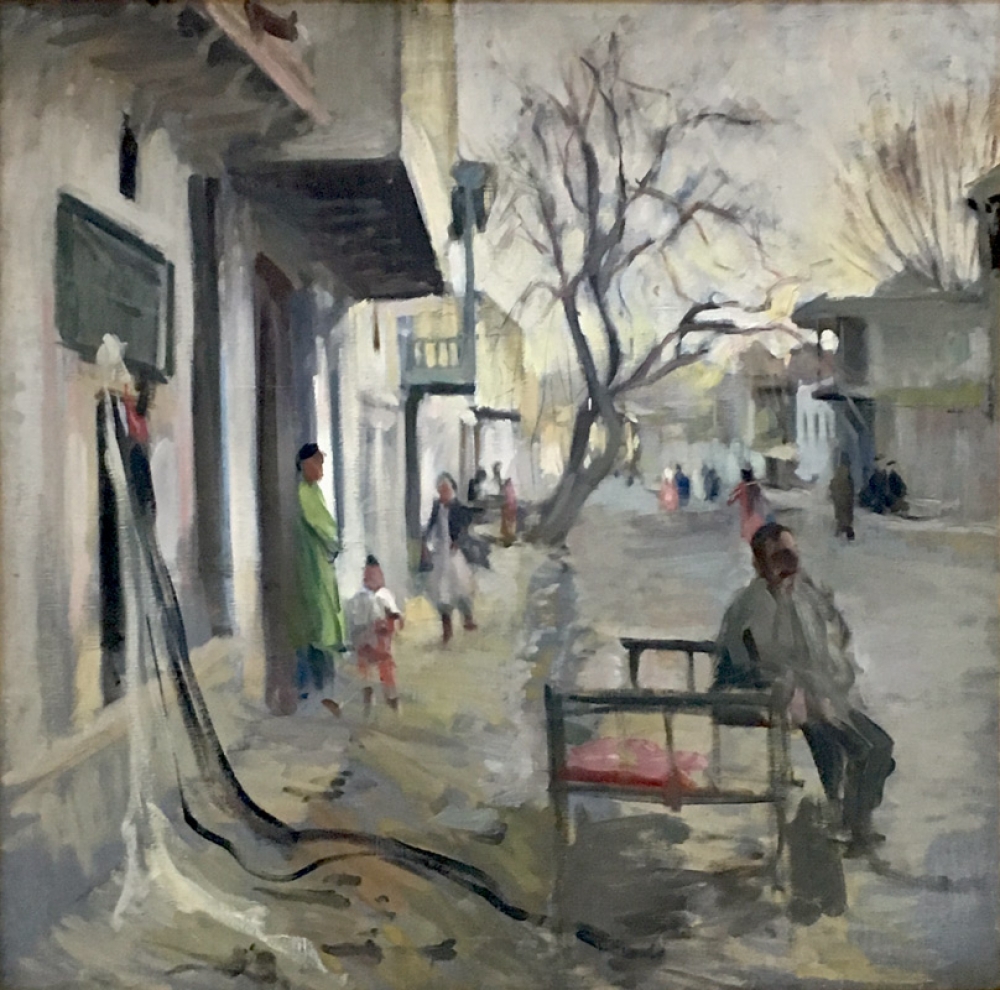
[Illustration: Zinaida Kovalskaia, Samarkand Street, 1948]
Keywords
Published : May 26, 2026