
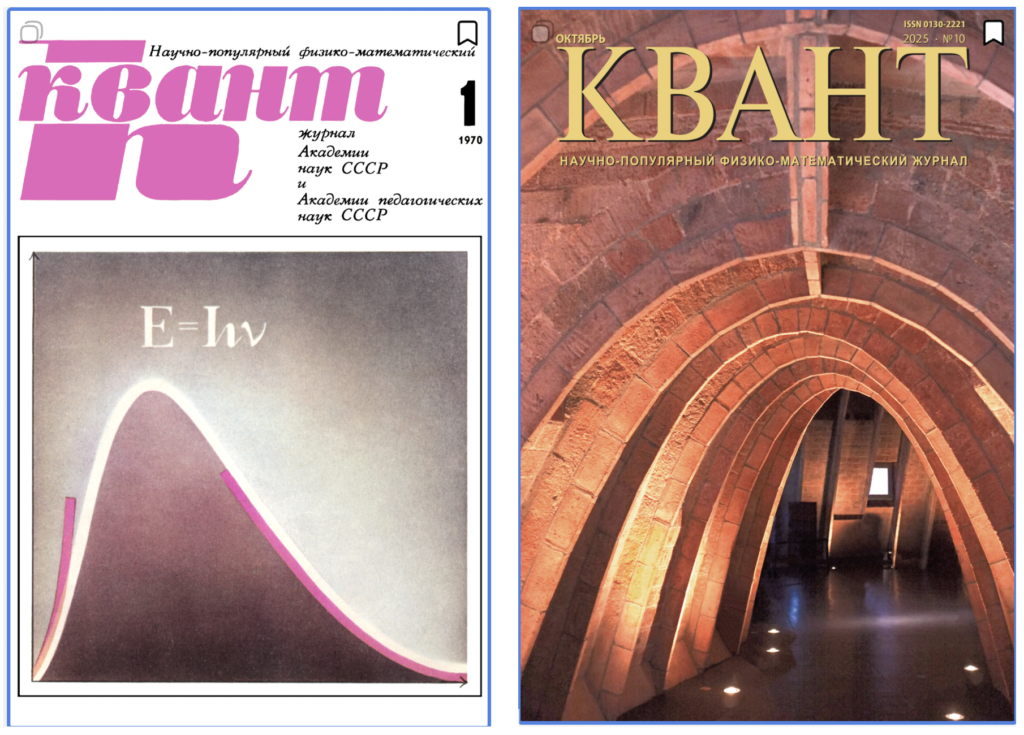
"Kvant" Popular Science Journal on Physics and Mathematics (1970-today)
The History of Kvant Magazine
The Kvant journal has been published since 1970, but the idea of creating a physics and mathematics journal for schoolchildren was conceived several years earlier. The idea of creating such a journal was first proposed by Academician P. L. Kapitsa in 1964. In January 1965, Academicians P. L. Kapitsa, M. A. Lavrentiev, I. K. Kikoin, A. N. Kolmogorov, I. V. Obreimov, and P. S. Aleksandrov wrote a letter about the creation of the journal to the Ideological Department of the Central Committee of the Communist Party of the Soviet Union [see Brook Yu. M. Kapitsa, Olympiads, and Kvant // Kvant. — 1994. — No. 5. — pp. 15—17]. The creation of the journal was discussed by those who, in the 1960s, organized physics and mathematics boarding schools at major universities, all-Union Olympiads, summer schools, and a correspondence mathematics school. These were not only academics, professors from leading universities, and teachers, but also young enthusiasts—scientists, graduate students, and undergraduates—for whom working with schoolchildren and popularizing scientific knowledge became a true calling and a second profession.
In pre-revolutionary Russia, the predecessors of Kvant can be considered the Journal of Elementary Mathematics (36 issues in 1884–1886, edited by V. P. Ermakov with the participation of E. K. Shpachinsky) and its successor, the journal Vestnik Oпытной Физики и Элементарной Математики (674 issues in 1886–1917, editors-in-chief: E. K. Shpachinsky, V. A. Zimmerman, V. F. Kagan).
In early 1970, the first issue of Kvant was published. The editor-in-chief of the new journal was the outstanding physicist, Academician Isaac Konstantinovich Kikoin, and the first deputy editor-in-chief was one of the greatest mathematicians of the 20th century, Academician Andrei Nikolaevich Kolmogorov. Both of them ran the journal until the last days of their lives. It should be noted that both Isaac Konstantinovich and Andrei Nikolaevich not only formulated the main objectives of the journal, but also carefully reviewed most of the materials submitted for publication and often participated in their direct editing. The first editorial board consisted of L. A. Artsimovich, M. I. Bashmakov, V. G. Boltansky, I. N. Bronstein (deputy editor-in-chief), N. B. Vasilyev, I. F. Ginzburg, V. G. Zubov, P. L. Kapitsa, V. A. Kirillin, G. I. Kosourov, V. A. Leshkovtsev (deputy editor-in-chief), V. P. Lishevsky, A. I. Markushevich, M. D. Millionshchikov, N. A. Patrikeeva, N. Kh. Rozov, A. P. Savin, I. Sh. Slobodetsky, M. L. Smolyan, Ya. A. Smorodinsky, V. A. Fabrikant, Ya. E. Schneider (executive secretary).
Over time, regular sections were established: articles on mathematics and physics, opening the issue; KMSh — Kvant for younger schoolchildren, which published problems and notes for very young readers; Mathematical Circle, Kaleidoscope, ...; sections that were important at the time without the internet, such as Olympiads, Applicant's Workshop, Examination Materials. For many years, the magazine has opened with the Games and Puzzles section and closed with the Chess Page.
A separate feature is the “Kvant Problem Book” section, which publishes original problems in mathematics and physics, followed by their solutions a few issues later. You can get an idea of what this is like from the selection in the anniversary issue No. 1 for 2020. These problems were solved in different cities across the country, and the lists of schoolchildren who sent in the correct solutions and the lists of winners were published in the magazine (you can try to find your surname or city on the “Issues” page).
From 1980, on the initiative of the editorial board of the Kvant magazine and with the support of the USSR Academy of Sciences, a series of books entitled “Kvant Library” began to be published, which became very popular.
During the Soviet era, the magazine was published by the USSR Academy of Sciences and the USSR Academy of Pedagogical Sciences. The inscription on the cover remains unchanged to this day: popular science magazine on physics and mathematics. In the 1970s, the magazine's circulation reached 386,000 copies per month. The history of our country can be traced through the magazine's circulation figures and publication frequency (and in earlier periods, through the publication of VOFEM issues).
Keywords
Published : January 13, 2026