
Lost Latvia in Old Drawings, Postcards and Photographs, 19th-21st Centuries
Lost Latvia is a project of the Latvian National Digital Library Letonica, which collects unique information about Latvia's lost and altered cultural and historical values.
Over time, Latvia's cultural landscape has changed significantly. Many natural, historical, artistic, and architectural sites, as well as economic and public buildings, have disappeared. Latvia's cultural heritage suffered greatly during the two world wars and the years of Soviet and German occupation. Many important sites have disappeared as a result of human economic activity and are still under threat today.
Lost Latvia contains digitized copies of old drawings, postcards, and photographs from the late 19th century to the present day, as well as descriptions of objects:
- architectural and artistic monuments (churches, manors, burial mounds, and medieval castle ruins);
- views of towns and villages;
- public buildings (municipal buildings, schools, community centers);
- economic buildings (factories, mills, ovens, craftsmen's workshops);
- infrastructure (postal buildings, shops, pubs, horse-drawn and railway stations, railways and roads, bridges);
- Latvian residents' dwellings; agricultural buildings (sheds, granaries, barns, and stables);
- natural objects (landscapes, ancient river valleys, cliffs, large trees, large stones).
The project also documents the economic, social, and cultural life of Latvian society since the second half of the 19th century (farm work in rural areas, old crafts such as the now-extinct profession of rafting, documentation of folk heritage and folk storytellers, activities of various societies and organizations, social life).
Lost Latvia invites everyone to get involved by adding descriptions of objects and sending new images and photographs.
The Lost Latvia project was created by the National Library of Latvia in collaboration with Latvian memory institutions—libraries, museums, cultural heritage protection and preservation organizations—and private individuals.
Lost Latvia is the first digital library of this scale at the National Library of Latvia. Close cooperation will promote the development of the project and improve and enrich the content of the project website.
The project is developed by Ginta Zalcmane, Aigars Staks, Edgars Jēkabsons, Mārīte Jankevica-Balode, Lāsma Timma, Kristīne Līce, Inta Beijere, Linda Jegorova, Agnese Pagrode, Solveiga Ķīkule, Liene Mukāne, and Laura Balode.
Participation in the EDLocal project of the European Digital Library's eContentplus program guarantees
the inclusion of data from the Lost Latvia project in the European Digital Library's Europeana portal.
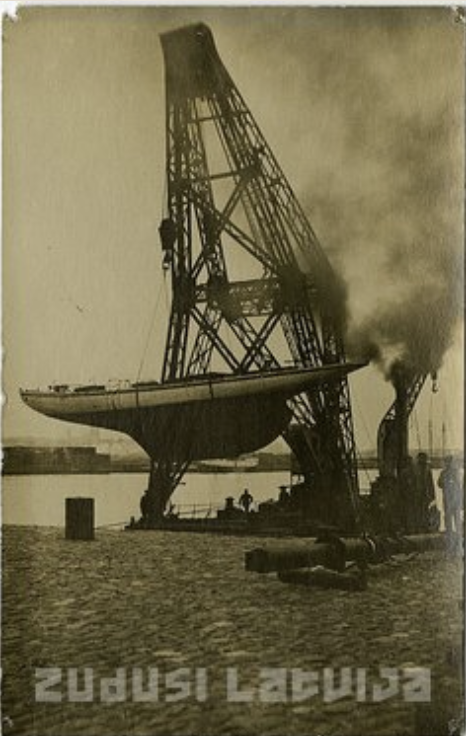
[Illustratio : The shipbuilding and machine factory JSC “Lange & dēls” in Riga was founded in 1870 under the name “A. Lange & J. Skuye.” The factory was once the main shipbuilding and repair company in Latvia. By 1912, 232 ships had been built there. In the 1920s and 1930s, the shipyard “M. Eller and P. Berg,” which later became the Riga Shipyard, as well as the machine factory “Georg Šattē un Ko” and other companies were located there. After World War II, the Riga Shipbuilding Plant was established there, LNB, R0409-30.]
Keywords
Published : June 11, 2025