
Portal of Art Monuments in East Central Europe
The portal was set up as part of the international joint project “Research Infrastructure for Art-historical Monuments in East Central Europe” (FoKO), funded by the Leibniz Association. The aim of the project was to build an interactive art-historical research infrastructure where the methods, concepts and products of digital art history could be applied and tested. As part of this initiative, a specific focus has been given to the – until now insufficiently acknowledged – achievements of art production in East Central Europe.
The international joint project FoKO placed special emphasis on the specific achievements of art production in East Central Europe, an area that has been characterized by complex historical dynamics. Until now, such achievements have remained significantly under-appreciated. Documentation data and picture collections relating to a canon of outstanding buildings, monuments and artworks were brought together from a range of international sources and made available for use. The goal here was to illustrate the many diverse interconnections that exist within the development of art in East Central Europe during the period from 1000-1800 AD just as clearly as the competing historical-epistemological references. Within a virtual setting, this comparative perspective provides us with vivid illustrations and allows us to discover new aspects of the history of style and tradition, of cultural transfer, patronage, and the formation of networks of artists and master builders.
In terms of content, the project was closely related to the publication project “Handbook on the History of Art in East Central Europe”, based at the Leibniz Institute for the History and Culture of Eastern Europe (GWZO) at Leipzig University.
The central tasks of the project included creating a data model based, on the one hand, on the CIDOC Conceptual Reference Model and, on the other, on the Functional Requirements for Bibliographic Records and that also related to the data model used for the deeper scientific indexing of photograph collections at the German Documentation Center for Art History – Bildarchiv Foto Marburg. In this context, the prototypical integration of standard data in a range of languages and mapping the most important terms in East European languages proved to be particular challenges. As a supra-regional, transnational digital workspace with an interconnected organizational form, FoKO offers users a highly effective and efficient research infrastructure for art history.
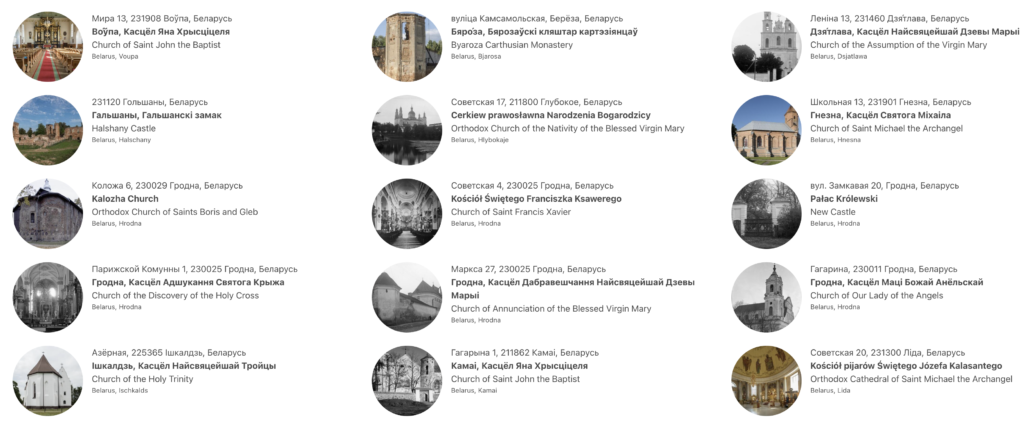
The photographs accessible via the portal document the diverse landscape of monuments and memorials in the countries of East Central Europe. They draw particular attention, both to central monuments of cultural heritage and also to those buildings that may be rediscovered as testaments to the region’s cultural history.
Great care was taken during the project to provide photographs of a high scientific and technical quality and all the pictures are available in the maximum resolution of the particular cameras that were used to take them. Attention has been given to specific technical details so that the monuments appear true to life. The possibilities afforded by motif design, cropping, formatting and depth of field have allowed for a precise and – as far as possible– neutral depiction of the photographed object in each image. Image sources from pre-existing collections were subject to a controlled selection process with the same criteria that were used for new photographs. Historical photographs, therefore, form a particular focus of the project, and allow us to document how monuments of cultural and historical significance have also changed across time.
We used the “Scientific Communications Infrastructure” (WissKI), which provided us with the necessary software and virtual research environment. WissKI enables the development of digital humanities applications using current standards and is a modular extension of the Content Management System (CMS) and web development framework Drupal. Data acquisition and data management in WissKI are based on a cataloging system that works according to semantic correlations using current Semantic Web technologies. The classification and storage of the collected data is based on the ISO standard 21127 (CIDOC-CRM). With this basis, solitary data is linked with a semantic network, making it possible for further and deeper connections to be seen immediately.
The project ran from 2014 to 2018 at the Herder Institute for Research on East Central Europe– Institute of the Leibniz Association (overall coordination), at the German Documentation Center for Art History – Bildarchiv Foto Marburg, and at the Leibniz Institute for the History and Culture of Eastern Europe (GWZO) at Leipzig University. It was run in cooperation with the art history institutes of the Polish, Slovakian and Hungarian academies of sciences and humanities in Warsaw, Bratislava and Budapest, with the Rundale Palace Museum in Latvia and with the Lithuanian Culture Research Institute in Vilnius.
Period
Keywords
Published : October 18, 2023