
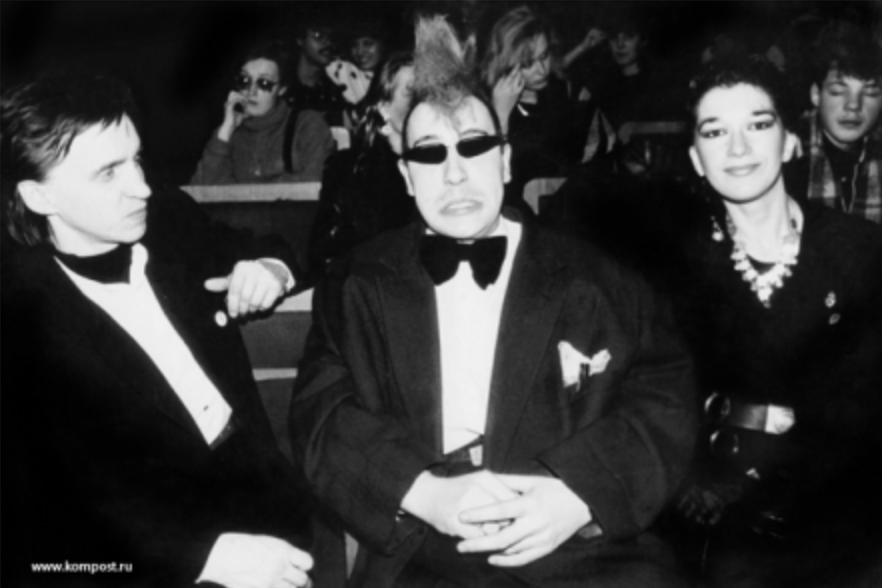
Youth Subculture in the 1980s
Project Manifesto www.kompost.ru
What's compost.
It is primarily an independent network art project of the "new archeology", which attempts to understand such a phenomenon as subcultures of the 1980s by the participants of informal movements themselves. The project reconstructs the history of subcultures with their own value systems, language, dress code and code of conduct. A communication chronicle of the major urban centres of the perestroika period is being created. Aspects of the phenomenon of collective memory are being touched upon.
The history of subcultural movements over the past 25 years has been overgrown with speculation and myths created in the media, cinematography and urban folklore. The urbanist sub-culture of Perestroika is currently described mainly from the point of view of rock journalism, by a few art critics of the 1990s and 2000s and freelance authors who combined the self-sufficient and heterogeneous formations of the underground into a single mass of "informal" and "Russian rock" fans. The authors of these publications first of all highlighted individual figures who fit into the new order of post-Soviet society, and significantly narrowed the narrative to a few events. As a result of vague description, the peculiarities of communication of underground environment - street, squatter and melomaniac environment, which penetrated almost all floors of perestroika society - fell out of the narrative. The communicative history of "street tribes" at the moment we try to recreate those periods in a context.
The current situation is also surprising because some subcultures got into the focus of media attention (styliagi, Beatniks, hippies, Newavers, Leningradsy, Rostovtsy, Novosibirsksy, Sverdlovsksy), while others as if did not exist at all. The history of Moscow punks, rockabills, metal workers, bikers, breakers and street-fighters has completely dropped out of the written chronicle. Which were the basis of subcultural movements of the capital's streets, where the confrontation between the official and underground reached its apogee, which took place not in political but in artistic and melomanian circles ...
The need to create an archive of subcultures was realized by the participants of underground movements, which are currently in the status of "underground underground", due to the fact that mythologies created in recent years began to grow into another layer of distortion and retelling. In recent history, apart from abstract "informals" and partly Hippocratic "system" of the 70's, the existence of another cultural stratum of several decades is simply not mentioned, and this situation no longer seems to be funny, but simply not acceptable. It is really difficult to put together the heterogeneous memories of the direct participants without losing the stylistic gradations, peculiarities of the street language and the multi-layeredness of this phenomenon. It is difficult even at the level of accents and vectors for understanding ... but we must try, at least because there is no one else.
Keywords
Published : March 20, 2020