
Encyclopaedia of Lithuania Minor
Lithuania Minor : a historical region divided between Lithuania and the Kaliningrad Oblast of Russia, and one of five ethnographic regions of Lithuania
The idea of compiling and publishing the Encyclopedia of Lithuania Minor (MLE) was raised in exile as soon as Lithuanians from Lithuania Minor arrived in Canada and the US, during the golden days of the Society of Friends of Lithuania Minor (MLBD).
The idea was raised again and accepted at the convention of the Lithuania Minor Foundation (MLF) on September 2, 1995, in Chicago. After ten years of MLF activity and the publication of ten books, the idea of the MLE had matured, so the MLF board immediately set about implementing the adopted resolution. A preparatory editorial board for the MLE was formed, consisting of the most active members of the Mažoji Lietuva Fund: from Chicago – W. Bendikas, R. Buntinas, I. Laisvėnaitė, J. Lampsatis; from Montreal – I. Pėteraitytė-Andruškevičienė, H. Lapinienė, V. Pėteraitis; from Toronto – A. Paulaitis, I. Šernaitė-Meiklejohn, R. Žviliūtė-Jocienė. Thanks to them, about 20 volumes of archival material suitable for the Encyclopedia of Lithuania Minor were collected, which proved necessary for the more accurate and complete preparation of the encyclopedia.
V. Pėteraitis, chairman of the editorial board of the preparatory Encyclopedia of Lithuania Minor and the Lithuania Minor Foundation, approached émigré and Lithuanian scholars and specialists in various fields, inviting them to participate in the preparation of the MLE. The response was encouraging. A whole group of experts on the region and culture of Lithuania Minor agreed to contribute articles, advice, and editing.
On June 10, 1996, the first meeting on the preparation and publication of the Encyclopedia of Lithuania Minor was held in Vilnius, at the premises of the Regional Studies Society, with 35 Vilnius residents in attendance. On June 16, 25 residents of Klaipėda and Šilutė participated in a meeting at the Klaipėda University Rectorate in Klaipėda. The meetings, attended by members of the Lithuanian Academy of Sciences, professors, associate professors, lecturers, researchers, and other employees of Mažoji Lietuva, highlighted the main features of the MLE: its scope, structure, and methodology.
The MLE will consist of several volumes, which are expected to contain about 9,000 articles and several thousand illustrations (maps, diagrams, photographs).
The encyclopedia covers historical Lithuania Minor – from Klaipėda in the north to Geldapė in the south, from Labguvos in the west to the Lithuanian border in the east, i.e., the historical lands of Nadruva, Skalva, and Pilsotas, which the Council of Lithuania Minor demanded be assigned to Lithuania during the 1919 Versailles Peace Conference. It also covers neighboring areas where Lithuanians lived only in isolated pockets, i.e., the northwestern part of Prussia, known as Tvanksta, which includes all of Semba and Notanga, as well as the northern parts of Barta and Varmė.
The Encyclopedia of Lithuania Minor is an original and popular regional universal encyclopedia written in alphabetical order, intended for all readers who are interested in Lithuania Minor, both in exile and in Lithuania, especially young academics. It is a gift to Lithuania, which is returning to the orbit of Western European thought, culture, and politics, from the disappearing or already disappeared Lithuanians and their friends.
The exceptional importance of this publication – it is an opportunity to immortalize the disappearing or already lost cultural heritage of the Lithuanians, Prussians, and Curonians, which is of inestimable value not only to Lithuanian and other Baltic cultures, but also to the culture of Europe as a whole.
This encyclopedia gives priority to what is Lithuanian, Prussian, Curonian, and Baltic. It highlights the authentic and distinctive features, characteristics, and uniqueness of the inhabitants of Lithuania Minor and Tvanksta.
It respectfully and lovingly presents the history, prehistory, culture, language and dialects, religious and literary works, folk and fine arts, rural and urban architecture, music and theater, cultural and social figures, societies, people and the land with its rivers, lakes, mountains and hills, generations of Lithuanians, settlements and parishes, memorable Lithuanian communities where cultural workers, public figures, teachers, priests and storytellers made their mark.
The MLE also mentions those East Prussian Germans who contributed to the culture and prosperity of Lithuania Minor. We remember with pain the Germanization, the post-war figures of the Kaliningrad region, the destroyers of the land and the exterminators of people, their colonization and Russification of Lithuania Minor, which they carried out and continue to carry out.
This scientific and informational publication is based on archival material from the Minor Lithuania Fund collected by the diaspora, as well as data collected and verified by contributors to the Encyclopedia of Minor Lithuania.
It is the first encyclopedia of its kind in the history of Lithuanian culture, as it contains only articles related to Lithuania Minor and Tvanksta, and on each page it includes words contributed by exiles and Lithuanian specialists, reflecting their different lifestyles. This makes the publication even more valuable and ensures that it will serve the Lithuanian people for a long time to come.
This enormous, complex, difficult, and meticulous work is being prepared by many specialists, not in a hurry, but with dedication, skill, and care, and the articles are being edited with love and devotion to Lithuania Minor by experienced editors.
The work of preparing the MLE was undertaken by the Science and Encyclopedia Publishing House (since 1997, the Institute of Science and Encyclopedia Publishing). Under the leadership of the late director Z. Pocius, an editorial board was formed, consisting of well-known figures from Lithuanian science, culture, and society. MLE leaders: Chief organizer and manager Vilius Pėteraitis, chief editor Zigmas Zinkevičius, deputy chief editor Martynas Purvinas, Deputy Editor-in-Chief for Publishing Vytautas Kaltenis, Executive Secretary Vytautas Gocentas, Language Editor Vaclovas Mikailionis, Editor-Coordinator Nijolė Dzindziliauskienė. MLE department heads – employees of higher education institutions and research institutions in Vilnius, Kaunas, and Klaipėda, as well as local experts. MLE is prepared by about 200 authors – well-known specialists in various fields.
The MLE editorial team, led by Dr. M. Purvinas since the summer of 1997, has experienced a number of crises over the past four years. The enthusiasm of the authors and editors has waned over time. Some left, others resigned from the editorial board. New people came along who were more supportive of our work, so the gaps that had appeared disappeared. The MLF's determination to overcome all the difficulties that hindered the work and not to doubt the success of the publication became an incentive to strive even harder.
With the publication of the first volume, we dispelled all doubts and will fulfill what we promised. Not only will we fulfill our promise, but we will also improve the publication when we publish the second and third volumes. With the second volume, we will publish a supplement listing all contributors, all donors to the encyclopedia, and comments from encyclopedia users.
The Lithuanian government and its ministries (Education and Science, Culture) also support the preparation of the MLE and have promised and allocated financial support. Unfortunately, the current financial situation in Lithuania does not allow for sufficient funding. Therefore, most of the funds for the first volume were received from the Mažoji Lietuva Fund, which was established by Lithuanian expatriates and their financial institutions (their contributions are listed on the first pages of the encyclopedia).
We are very grateful to all our collaborators and the authors of the articles, whose names are listed after each article or illustration.
Special thanks are due to the "engines" of the encyclopedia – the editors of the MLE preparation group, who worked from the very beginning, deliberated, and created this monumental written monument to Lithuania.
I would also like to take this opportunity to thank the directors and staff of the Institute of Science and Encyclopedia Publishing, who helped to complete this publication with their advice and publishing resources.
Vilius Pėteraitis
Chairman of the MLF (1992–1998),
Chief Organizer and Editor of the MLE
Montreal, June 16, 2000
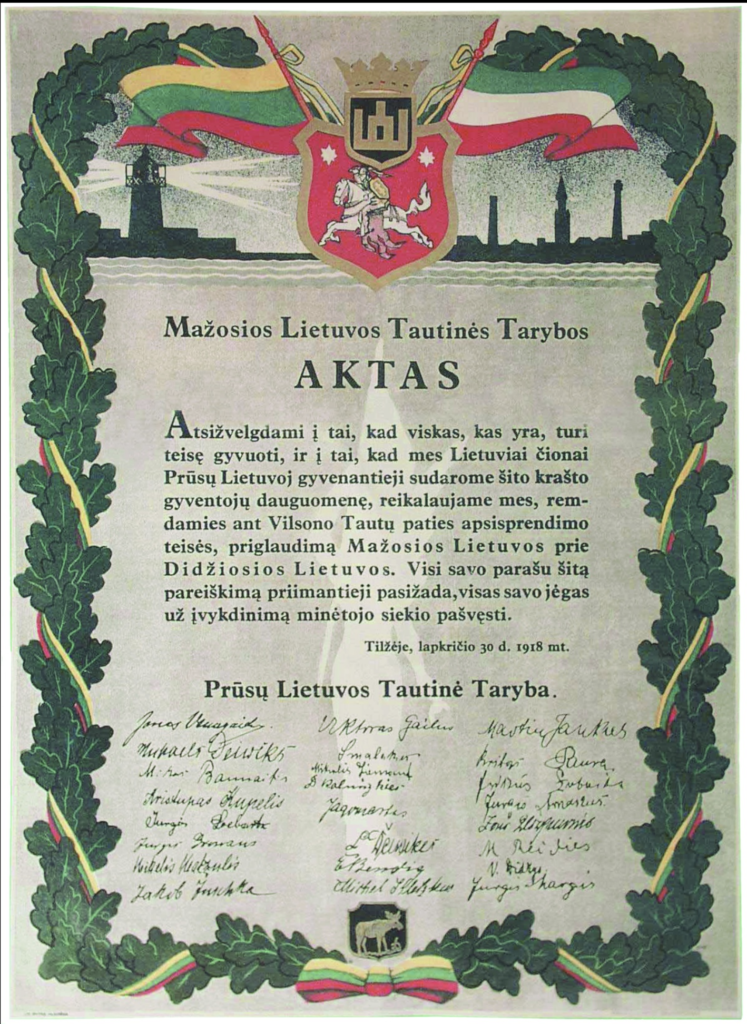
[Illustration: Act of the National Council of Lithuania Minor, signed on November 30, 1918]
Geographical area
Keywords
Published : January 15, 2026