
"Eurasia by Bike" - Lucien Péraire's (1906-1997) Bicycle Journey Across Eurasia
Eurasia by bicycle
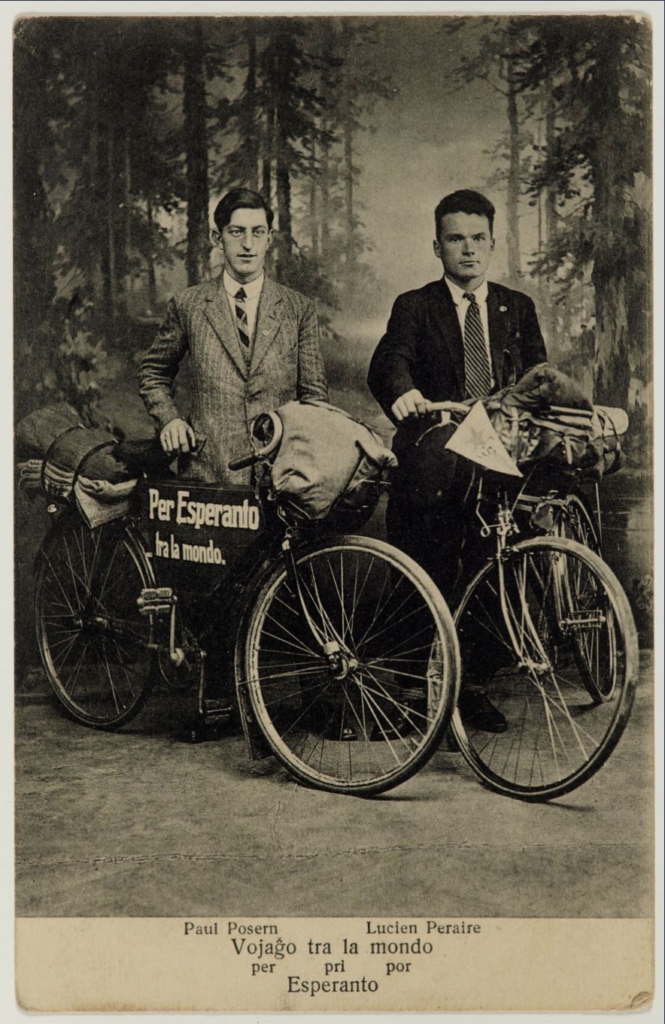
Between 1928 and 1932, Esperanto worker Lucien Péraire (1906-1997) embarked on a bicycle journey across Europe, the USSR, Manchuria, Japan, China and Indochina as far as Java. Initiated in the wake of the First World War and the trauma it inflicted on his generation, the journey was part of his desire to understand the causes of enmity between nations, and to demonstrate that a transnational community of solidarity is possible through the worldwide network of Esperantists. [...]Crossing Europe on borrowed time
The journey begins through Austria, Hungary, Poland and the Crimea to Novorossiysk on the Black Sea, which they reach in the middle of winter. They often stayed with Esperantists, who solved many practical and bureaucratic problems. In many places - even the most isolated - they meet samideanoj, with whom they share not only the language but also a certain vision of the world. Many of them accompany them by bike for a few days or weeks. In Crimea, they receive help from the children of a kolkhoz, who learn Esperanto from an itinerant teacher. The cycling companions modestly finance their lives by selling postcards about their expedition and organizing evening talks and songs. Paul and Lucien obtain their Soviet visas in Poland and enter the country by rail, according to customs rules, on an almost empty train. In Ukraine, “the stigma of the recent civil war is ever-present: houses with leprous facades, or half-demolished. An indefinable discomfort hangs over everything”. As they left the Soviet Ukraine, a major obstacle awaited them: in Russia, the roads disappeared and were replaced by muddy pavements. The journey slows down.The USSR, hopes and disappointments
During the winter, in Novorossisk or Irkutsk, Lucien works in the factory. Political activities punctuated his work. In December 1928, Paul and Lucien decided to separate. Paul continued on to Baku, hoping to pass southwards through Persia and India, but, lacking a visa, he eventually turned back through North Africa, and reached Europe via Spain. Lucien decided to take the northern route, across Siberia to Asia. To make progress in the absence of passable roads, he designs and builds a bicycle in Kazan that allows him to ride on the Trans-Siberian railway. With the support of his Esperantist friends, and after several visits to Moscow, he obtained authorization to use this original means of transport. [...}
Published : January 07, 2025