
Archives of Historical and Ethnographic Yiddish Memories (AHEYM)
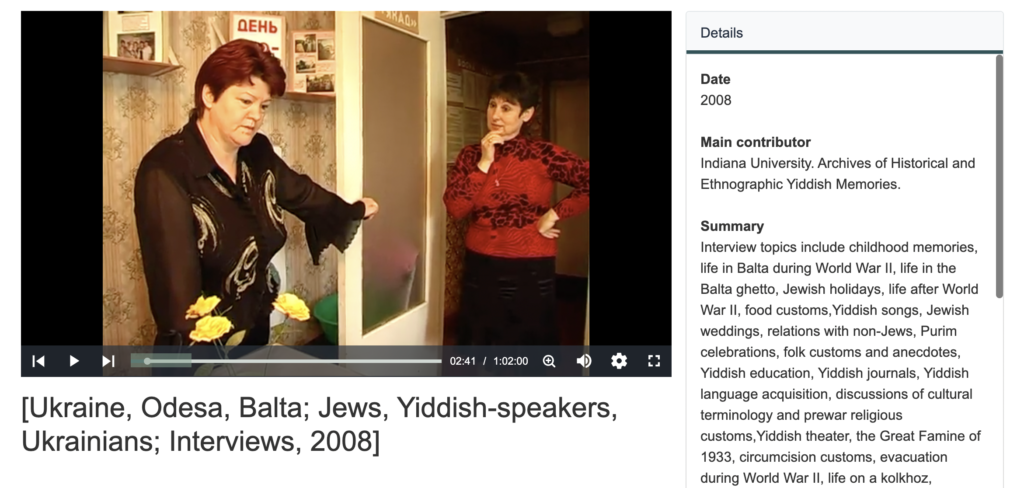
The Archives of Historical and Ethnographic Yiddish Memories (AHEYM—the acronym means "homeward" in Yiddish) includes approximately 800 hours of Yiddish-language interviews with 350 individuals, most of whom were born between 1900 and 1930. The interviews were conducted in Ukraine, Romania, Moldova, Hungary, and Slovakia. The interviews include:
- linguistic and dialectological data;
- oral histories of Jewish life in Eastern Europe;
- Holocaust testimonials;
- musical performances (including Yiddish folk songs, liturgical and Hasidic melodies, and macaronic songs);
- folklore, including anecdotes, jokes, stories, children's ditties, folk remedies, and Purim plays;
- reflections on contemporary Jewish life in the region, and;
- guided tours by local residents of sites of Jewish memory in the region.
In the period before the Second World War, much of the Jewish population of Eastern Europe lived in small towns, or shtetls, scattered throughout the Soviet Union, Poland, Lithuania, Romania, parts of Hungary, and Czechoslovakia. In the aftermath of the war, however, surviving Jews abandoned the shtetls and the Yiddish language and found instead a future in the larger metropolises, where they lost many of the local customs, beliefs and practices that had defined Jewish identity in the prewar shtetl. There were, however, many Jews who remained in the small towns of Eastern Europe. Some returned from evacuation after the war, others came out of hiding, and some literally crawled out of mass graves to reclaim their lives. This population group that remained in their native region is the subject of the Archives of Historical and Ethnographic Yiddish Memories.
Yiddish language and culture are intricately intertwined with the Eastern European shtetl from which they emerged. The language itself is a fusion language incorporating Hebrew, Aramaic and Slavic components into a predominantly Germanic structure, and is intimately association with other defining characteristics of Yiddish culture—its cuisine, music, plastic art, theater, and architecture—all of which are as much products of small-town Eastern Europe as they are of the traditional Jewish religious way of life. Whether it is borsht, klezmer, Jewish humor, Chagall or wooden synagogues, contemporary notions of Yiddish culture are inseparable from the territory of Eastern Europe in general and the shtetl in particular. Although literary Yiddish and highbrow Yiddish culture is most saliently a product of the city, and particularly major metropolitan areas like Vilnius, Warsaw, Kiev, and Odessa, it is the experience of the shtetl that has most captured public imagination.
The interviews address issues of Jewish life cycles, family structure, religious observance, community organization, cultural activities, education, health, recreation, cuisine, folklore, language, and linguistics. At the same time, they document and trace dialectological data in order to establish more accurate isoglosses in an effort to map out the historical division of Yiddish dialects, and to retrace the development of the Yiddish language and the dynamics of interregional connections via the spread of Hasidism, Enlightenment, and modernization.
To facilitate cataloging and discovery, this large collection has been divided the Archives of Traditional Music into subcollections by locality.
Keywords
Published : May 28, 2024