
Oral History of Forced Relocations in Ukraine and Poland after World War II
The Krasne project - a resettlement hub was implemented in 2012 in the western Ukrainian towns of Busk and Krasne by an international team of researchers and NGO activists Dobra Volya and Women's Foundation (Krakow, Poland), International School of Equal Opportunities (Kyiv), Jugendwerk der AWO Württemberg »(Stuttgart, Germany) and« MONAliesA eV » (Leipzig). The project received financial support under the program "Geschichtswerkstatt Europa" of the German Foundation "Memory, Responsibility and Future".
The project focused on studying the experience of forced relocations at the end of World War II and the first years after its completion. In 1945, in accordance with the agreements of the Yalta and Potsdam conferences, the eastern regions of Germany became the western Polish lands. As the Red Army approached, part of the German population fled, and those who remained were gradually evicted by the new government. Their houses were occupied by Polish families of immigrants from the East, from the territories included in the USSR. In turn, in 1944-46, Ukrainians living in the border areas were massively relocated from Poland to the Ukrainian SSR. Ukrainians resettled from eastern Poland settled in Krasny and Busk.
Most of the men fought in various armies during these events, so women and children were the first to be relocated. Therefore, the main task of the project was to study the memory of women in the context of everyday life and to study the specifics of historical experience from the perspective of their stories (her-stories). After all, these stories represent a unique and different from the male vision perspective, focusing on routine daily practices, the struggle for survival, a common destiny that does not depend on nationality and social origin.
According to one of the participants in the project, Halyna Bodnar, "the project did not aim to study the history of resettlement from the point of view of just one people affected by the disaster, as it affected everyone equally: Ukrainians, Poles, Germans, Jews and other peoples. on the other hand, documenting the memories of modern residents of Krasny (representing different nations) and the surrounding area about the tragic events of the past, interethnic relations in difficult life circumstances took place from a woman's perspective. historical literature, but who carried on their shoulders the entire burden of the daily routine of family survival, survived the death of loved ones and children. However, their traumatic experience (resettlement, famine, violence, violence) remains unspoken, silenced, hidden, but so that still hurts ...
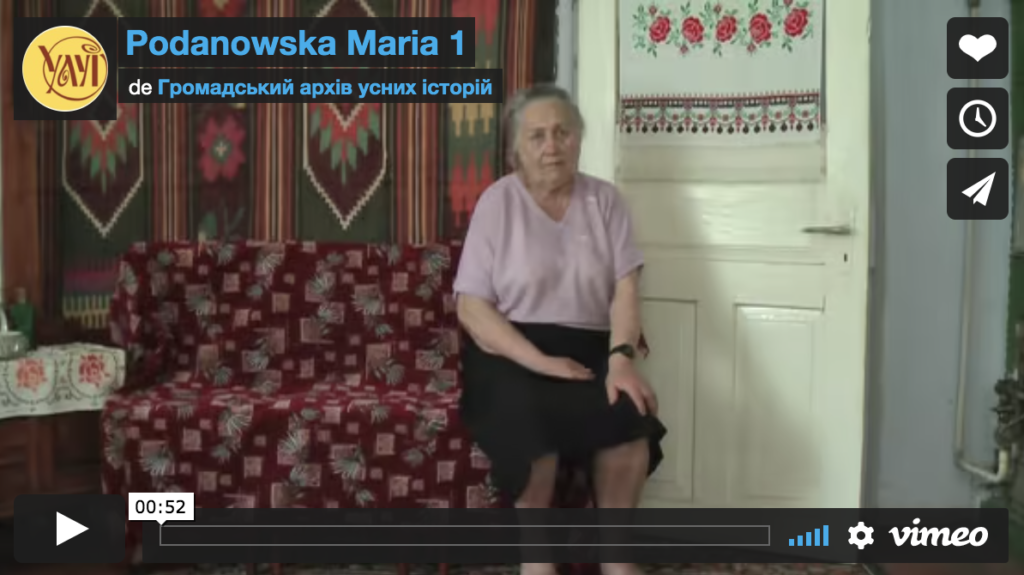
For two weeks, an international team of 12 young women from Poland, Ukraine and Germany studied the history of forced post-war resettlement in Krasny, Busk and the surrounding area. Video interviews were conducted with 19 women, in which they tried to get answers to a number of important questions: "What was the fate of Ukrainian women displaced from Zakerzon?", "How did Ukrainians live in those areas in Soviet times?", "Do local women remember? "How many more traces of the polyethnic and multicultural past of the area have survived?" Each interview began with a request: "Tell us about your life." This made it possible to identify the most painful moments in the life of the narrators, what hurt them the most and what they wanted to tell. The project participants listened to stories about various resettlements: mostly about leaving modern-day eastern Poland for Ukraine, but also about working in Germany during the war, deportation to Siberia. No less dramatic were the stories of local residents who had no experience of resettlement (Poles who did not go to Poland or local Ukrainians in the postwar years), but witnessed the eviction of a close family, Ukrainian and Polish neighbors, the murder of Jews ... "(Source )
Extracts of 17 interviews available on the site.
Keywords
Published : November 09, 2021