
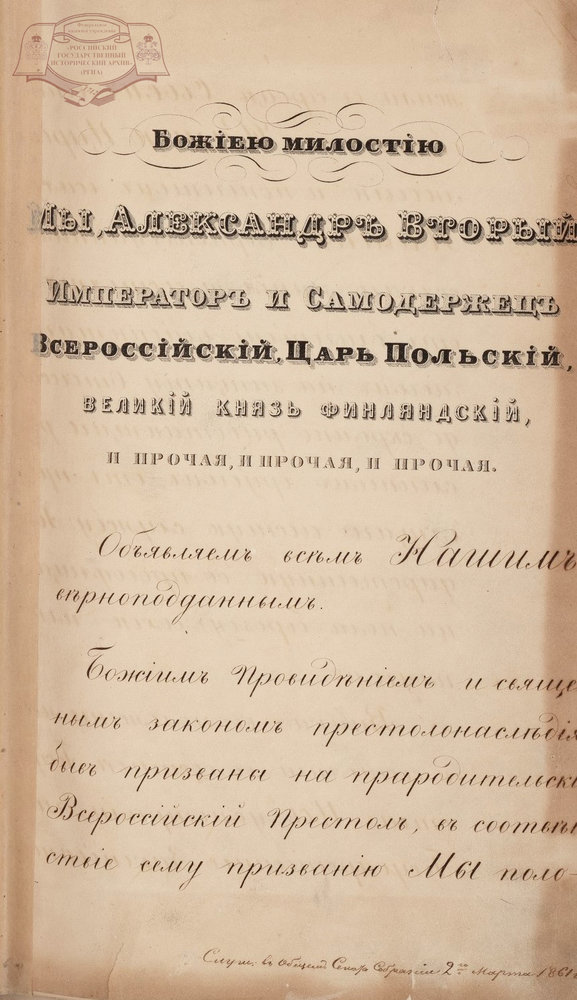
Alexander II, Emancipation Manifesto, 1861
"Manifesto on the Abolition of Serfdom; Provisions of February 19, 1861. - These are the most important legislative acts related to the major event of the 19th century Russian history - abolition of serfdom. Development of this set of documents began in the second half of 1850s. The preparation and realization of the reform took place in the most difficult foreign and domestic political situation in the country. As early as March 1856, speaking to the Moscow nobility, Emperor Alexander II stressed: "It is better to destroy serfdom from above than to wait until it begins to destroy itself from below."
The documents of the peasant reform were drafted by a group of liberal-minded officials, representing the color of the Russian bureaucracy. They included the Manifesto on the Abolition of Serfdom, 2 decrees to the Governing Senate, "Regulations on the peasants freed from serfdom" (17 legislative acts and 5 appendices to some of them).
The Manifesto was proclaimed on March 5 (new style) in the Assumption Cathedral of the Moscow Kremlin and St. Isaac's Cathedral in St. Petersburg, and then in other cities. The day of Manifesto's reading was not chosen by chance, because on March 5, 1861 "the Sunday of forgiveness" was falling.
The Manifesto on the Abolition of the Serfdom and the Statute of February 19, 1861 regulated the economic relations between the peasants and the landlords during the period of serfdom and the process of redemption. They regulated in detail the process of emancipation of various categories of landlords and peasants under servitude in different regions of the Russian Empire and the order of redemption operation. Legally terminated the norms of serfdom in Russia.
Abolition of serfdom contributed to the economic and social development of Russia, opened up opportunities for the transition from an agrarian to an industrial society, establishing a new system of social relations and completing the pan-European cycle of transformations in the agrarian sector. At the same time the land problem was solved in a half-hearted way. The peasants were given an allotment for which they had to pay a ransom to the landlord ("redemption payments"). Peasant farms were subordinated to the community, which was collectively responsible for paying taxes, redistributed land among farms, limited personal initiative of peasants and the possibility for them to move to towns, which in turn inhibited industrial development.
Records of peasant reforms are included into the State Register of Unique Documents of the Archive Fund of the Russian Federation by the decision of the Central Electoral Commission of the Federal Archive Agency.
Here is the Manifesto of Emperor Alexander II of February 19, 1861 "On donation to the serfs the rights of free villagers and on arrangement of their life" (RGIA. F. 1329. Op. 1. D. 730 b. P. 27-41 ob) and the "General Statute on the Peasants Freed from Serfdom" (RGIA. F. 1329. Op. 1. D. 730 b. P. 53) approved by the highest court on February 19, 1861.
Published : September 08, 2021