
Testimonies of Soviet Survivors of Nazi Occupation
Institution
Most of the interviews presented here were the work of a group of historians led by the Moscow history professor Isaak Izrailevich Mints. Early on, Mints recognized the historical significance of the Soviet war against the Nazi invaders. By December 1941 he had formed a “Commission on the History of the Great Patriotic War,” with the aim of collecting documents for a vast postwar chronicle of that war. Central to the documentary efforts of the commission was the creation of oral histories. By war’s end, the commission had created close to 4000 interviews with soldiers and civilians, men and women, engaged in the Soviet war effort.
As a distinct chapter of their work, the historians sought to document the Soviet experience of Nazi occupation. Toward this purpose, they dispatched tandem teams of a historian and a stenographer each into regions and towns that had just been liberated by the Red Army. In smouldering towns and villages throughout western Russia, in Ukraine, Belorussia and elsewhere, the historians gathered testimonies from more than 700 witnesses and survivors of Nazi rule, often within weeks or months of the Germans’ departure. The historians interviewed a wide range of witnesses: teachers, engineers, industrial workers, party officials and peasants; men and women who had fought the Germans as partisans, as well as churchmen who struggled to explain why they had included Adolf Hitler in their public prayers.
The work of the Moscow Commission, also known as the “Central Commission,” spawned further documentary efforts. Later during the war, Ukrainian and Belarus commissions formed in Kiev and Minsk. They closely cooperated with the Moscow historians and adopted their methodology.
The candor and richly shaded texture of the interviews sealed their fate. After war’s end, neither of the commissions that had formed was able to obtain approval for publication from state censors, and the documents they collected disappeared in archives in Russia, Ukraine, and Belarus. They are now presented here for the first time.
Further readings on the work of the Moscow Commission is d: D. D. Lotareva, “Komissiia po istorii Velikoi Otechestvennoi voiny: istoriia sozdaniia, osnovnye etapy I rezul’taty deiatel’nosti,” in: Velikaia Otechestvennaia – izvestnaia i neizvestnaia: istoricheskaia pamiat’ i sovremennost’ (Moscow, 2015), pp. 159-165; Jochen Hellbeck, “The Antifascist Pact: Forging a First Experience of Nazi Occupation in the Wartime Soviet Union,” Slavonic & East European Review 96.1 (2018), pp. 117-143.
The documents are presented in the original Russian language as well as in English and German translation.
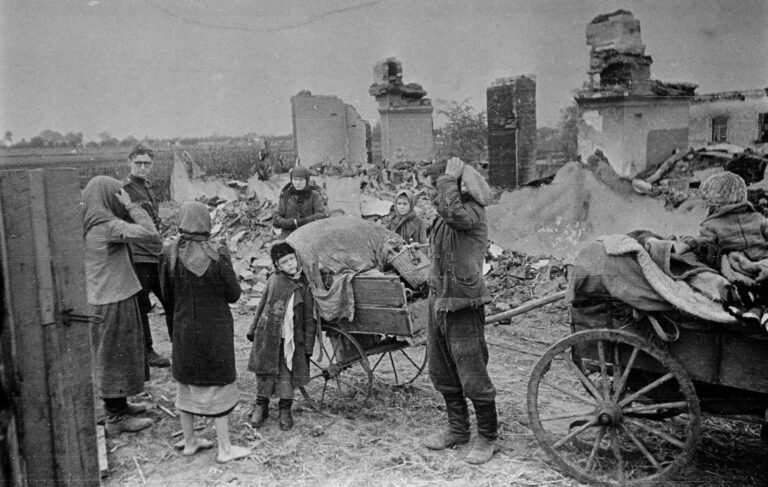
[Illustration: Residents of the Poltava region in front of their destroyed house, 1943. Photographer: Semen Fridlyand. Source: The Dalbey Photographic Collection at the University of Denver.]
Published : June 23, 2021