
Culture and Everyday Life of the Nobility in the Eighteenth-Century Russian Provinces Project
Url
Our site is part of the database accumulated as a result of the work of a team of researchers from three countries (Russia, Germany, Canada) on the project Culture and Life of the Russian Nobility in the Province of Orel, Tula and Moscow in the 18th Century.
The project was implemented in 2009-2015 under the auspices of the German Historical Institute in Moscow.
Project leader: O.E. Glagoleva (Russia, Canada)
Project leader: I. Schierle (Germany)
During the project implementation our database had collected information on almost 10 thousand noblemen of the three regions under study, created personal pages for almost 6 thousand noblemen, as well as accumulated data on 2.5 thousand noblemen's estates and manor houses. The project focused on the nobility of the Orel, Tula and Moscow provinces (as well as districts, included into the reform of 1775 in the same name provinces), which took part in the campaign to convene the Statute Commission in 1767-1774. Taking as our starting point the approaches, first of all, of local history, we set ourselves the task to look at the events of the convocation and work of the Commission on the composition of the new Ulozheniye (Code) 1767-1774 in the context of local history.
Our site, with its unique, specially designed for the project method of accumulation and placement of data, offers a wide range of materials and possibilities for researchers of Russian history and culture of the 18th century.
First of all, the site presents materials on the nobles who took part in the campaign to convene the Established Commission at the local level - participants in the elections, held in 1767, elected deputies and noble leaders, the nobles who were unable, for whatever reason, to personally participate in the elections and who sent written "reviews" to the provincial and municipal offices. The personal pages, created on the basis of a specially designed template with 72 parameters, show noblemen not only in the light of their service biographies and data on their property and social status, but also in the circle of their families, relatives and neighbors, which allows to clarify the personalities of these people, to recreate the multilateral relations in the local noble communities.
For users' convenience, all the names of the nobility, which have personal pages, are included in the list All noblemen. It also includes names with different spelling (e.g., Agarev Alexey Petrovich and Ogarev Alexey Petrovich; Afrosimov Egor Ivanovich, Efrosimov Egor Ivanovich and Afrosimov Egor Ivanovich) in alphabetical order which leads to the same personal page of this person.
Automatically generated categories of Persons, Noblemen, Men, Women, etc., presented at the bottom of each personal page, help to see not only the constantly increasing number of personal pages available on the site, but also the social, gender, age and other composition of people whose data is presented here.
The site presents all the aspects of the participation of the nobility of the three provinces in the campaign to convene the Ulozhennaya Commission, which have been revealed to date - the decrees composed by them, the data on the work of the deputies in the sessions of the Commission, the "opinions" of the deputies on various problems discussed in the Ulozhennaya Commission.
Our site provides researchers with lists of estates and manors, as well as lists of property owners in different provinces and counties, compiled according to Economic Notes to the General Land Survey, documents of sale-purchase, inheritance and other sources, allowing them to see specific characteristics of estates and manors of nobility, compiled on special pages.
A unique development of our site is the Categories section, which allows not only to see lists of people formed according to certain criteria (e.g., deputies, military, officials, debtors, etc.), but also to search in several categories simultaneously, including or excluding certain parameters (Search in several categories (intersection of categories)).
Under the terms of the project, the full versions of some archive documents, fragments of which are usually published on personal pages of noblemen or estates, as well as the service pages of the research team's work remained closed. The visual presentation of data, multilevel and interactive interaction between different blocks of information, the placement of not only textual but also graphic materials allow our site to offer researchers a clear and extremely valuable picture of the historical process in all its diversity, depth and versatility, to recreate a vast canvas of provincial life of the second half of the 18th century. All materials of the site is a full electronic publication, protected by copyright of the project participants and creators of the site. Using them without reference to the site is prohibited.
If you have any questions, please contact: olga.glagoleva@utoronto.ca
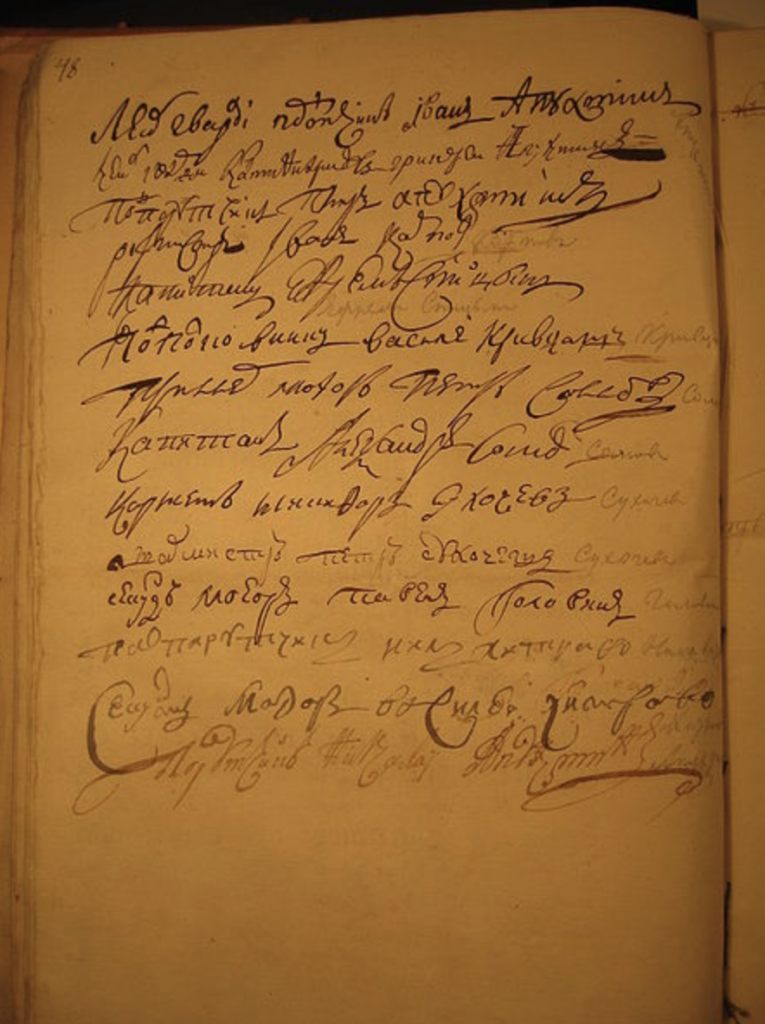
[Illustration: Grigory Apukhtin's signature under the decree of the Bolkhov county nobility. Second from the top. April 14, 1767 RSGADA. Ф. 342. Opt. 1. Д. 109. Ч. 10. P. 25 ob.]
Keywords
Published : May 04, 2021