
Poznan Second World War Archive
When it was decided in the second half of 1946 to set up the Archives, it was assumed that its task would not be the collection of documents, since other institutions had been set up to fulfil this function. Professor Karol Marian Pospieszalski, the Archive's creator, intended it to be a handy collection of materials created from certified copies of documents.
However, original German documents and photographs obtained in 1945-1948 were also secured. Thanks to the Professor's initiative, in those first, post-war years, documents created by various institutions of the German administration and found in buildings in which they had their seats between 1939 and 1945 were handed over to the Institute. Moreover, such materials or photographs were abandoned in private apartments abandoned by Germans in 1945.Also in the following years, the collections of the Institute were enriched by private individuals who donated valuable documents, materials, periodicals and photographs to the Archives. Moreover, the resources of the Archives have been supplemented with materials collected for the needs of the research work conducted at the Institute. And so for the history of the conspiracy in Wielkopolska, including secret teaching and cultural activity, Professor Edward Serwañski collected extensive documentation in the form of accounts and testimonies of witnesses.
Particularly important for research on German crimes committed in the Fall of 1939 in Gdańsk Pomerania are witness testimonies collected in the 1960s by Dr Barbara Bojarska. Extensive material in the form of documents and valuable correspondence was collected in the 1970s during research conducted by Professor Edward Serwański and Professor Maria Rutowska together with the Main Commission for the Investigation of Nazi Crimes in Poland into losses of the Polish intelligentsia during World War II.
Similarly, documents and other archival materials collected during the research on material losses in Poznań, deportations of the Polish population to the General Government, and in part on the independence conspiracy in Wielkopolska during World War II were transferred to the Archives. In 1991, this vast collection of documents, archival materials and photographs, comprising some 3750 inventory items and 7000 photographs, was officially named the Archives of World War II.
The archival collections of the Western Institute are unique not only in Poland. However, the state of preservation of some documents and periodicals did not make it possible to make them fully available in accordance with the demand. In this situation, efforts have been made to raise funds for the digitisation of the entire collection of the Archive. In 2011. The Ministry of Science and Higher Education within the 'National Programme for the Development of the Humanities' awarded a grant for the digitisation and new processing of the entire collection of the Archives of World War II. This project was carried out in 2011-2015 under the direction of Professor Maria Rutowska.
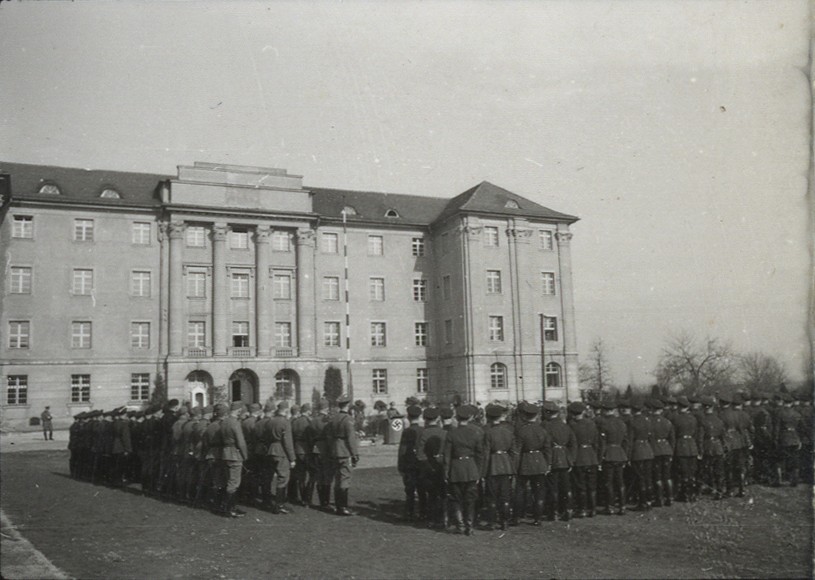
[Illustration: Opening of the German police school in Gniezno in 1940. The school was intended for auxiliary police.]
Published : May 03, 2021